Standfirst: T-Marker uses coded scan bodies, an iPad Pro or recent iPhone Pro and a subscription app to record multi-unit abutment positions. A new one-patient clinical study reported lower linear and angular discrepancies than an intraoral-scanner workflow, but it did not test prosthesis fit, long-term outcomes or performance across varied arches.
TruAbutment’s T-Marker attempts to move full-arch implant photogrammetry from a dedicated camera onto a consumer device already found in many clinics.
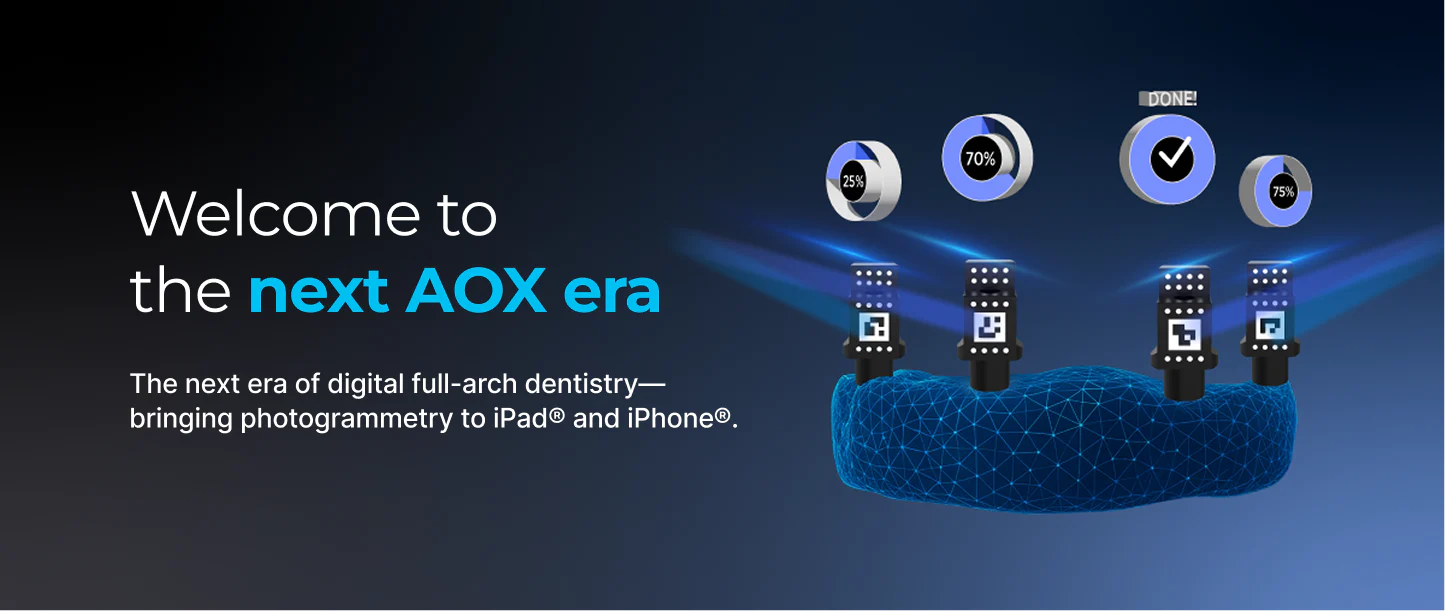
The system uses reusable coded markers attached to multi-unit abutments, the cameras of a compatible iPad Pro or iPhone Pro and the T-Marker app. The software calculates the relative implant positions and exports an STL file for the restorative workflow.
Its commercial argument is accessibility. The AOT- and URIS-compatible kits are listed at $3,000, the Straumann-compatible kit at $4,000, and unlimited STL exports cost $99 per month, $499 for six months or $899 per year.
The scientific argument became more interesting in June 2026, when The Journal of Prosthetic Dentistry published an in-vivo comparison involving T-Marker.
The study reported an overall linear discrepancy of 49 ±13 µm and an angular discrepancy of 0.26 ±0.02 degrees for T-Marker. Both were significantly lower than the results of the tested IOConnect workflow using a TRIOS 5.
That is encouraging evidence. It is not yet broad clinical validation.
What T-Marker captures—and what it does not
T-Marker records the three-dimensional positions and angulations of multi-unit abutments. It does not, by itself, capture the entire denture-bearing surface, soft tissue, occlusion or facial relationship needed to design a full-arch prosthesis.
The positional STL must therefore be aligned with other records, which may include:
- an intraoral scan of the tissue and provisional prosthesis;
- a laboratory scan;
- a conventional impression;
- pre-operative and post-operative records;
- a scan of the opposing arch and bite;
- facial or jaw-relation data, depending on the workflow.
This distinction is central to the buying decision. T-Marker may replace a dedicated photogrammetry camera for one acquisition task, but it does not eliminate the rest of the full-arch data chain.
TruAbutment markets the system as open because it provides unlimited STL exports. The company also offers T-Marker libraries for exocad and 3Shape through its download platform.
How the mobile workflow works
The clinician attaches a T-Marker component to each multi-unit abutment and records the coded markers from multiple viewpoints with the app. Photogrammetric calculations determine their spatial relationship without a separate calibration process.
The manufacturer says the system requires an iPad Pro or an iPhone 15 Pro or newer Pro/Pro Max model. It is not available for Android, and the Apple device is not included in the kit price.
The absence of a cable and a separate camera cart is attractive. It also moves part of the regulated clinical workflow onto a consumer hardware platform whose operating system, camera APIs and model availability are controlled by Apple.
Practices should ask:
- which exact devices and operating-system versions are validated;
- what happens if an iOS update changes app or camera behaviour;
- whether older supported devices will remain supported;
- how cases are stored, transferred and backed up;
- what offline functionality exists if internet access is interrupted.
App Store records show that the software continues to receive fixes and compatibility updates. That is reassuring, but it also illustrates why lifecycle support belongs in the procurement discussion.
What the 2026 clinical study found
The new clinical study compared two ways of recording a complete-arch implant situation in one patient with four implants and four multi-unit abutments.
For the reference, the investigators made three scans with a Micron Mapper extraoral photogrammetry system and used the average linear and angular measurements.
They then evaluated:
- IOConnect: noncalibrated scan bodies captured with a TRIOS 5 intraoral scanner;
- T-Marker: T-Marker scan bodies recorded with the app and an iPad Pro.
The results were:
| Measure | T-Marker | IOConnect |
|---|---|---|
| Overall linear discrepancy | 49 ±13 µm | 68 ±13 µm |
| Overall angular discrepancy | 0.26 ±0.02° | 0.42 ±0.07° |
The difference in linear trueness was statistically significant at P=.023, and the angular difference at P<.001. T-Marker also produced better angular precision, while the two techniques had similar linear precision.
The authors concluded that the acquisition technique affected accuracy but that both methods could provide a reliable way to record implant positions.
This is a stronger signal than a benchtop demonstration. The system was used in a patient, and the comparator was a relevant contemporary workflow.
Why the evidence must remain in proportion
The study involved one patient, one arch configuration and four implants. Repeated measurements can estimate precision within that situation, but they do not transform one anatomy into a representative patient population.
The study did not establish performance across:
- maxillary and mandibular arches with different curvature;
- four, six and eight implants;
- different interimplant distances and angulations;
- restricted mouth opening;
- blood, saliva and moving soft tissue at immediate-load surgery;
- different compatible Apple devices;
- different operators and experience levels;
- all T-Marker connection families;
- worn or repeatedly sterilized markers.
It also measured digital positional discrepancies. It did not manufacture and clinically test a series of definitive frameworks.
Passive fit depends on the complete workflow: marker seating, library accuracy, dataset alignment, CAD, manufacturing, material behaviour and component tolerances. A 49-µm scan result cannot be interpreted as a 49-µm prosthesis misfit.
The research is best described as a promising clinical pilot.
The regulatory record is narrower than “the system”
The US AccessGUDID record lists T-Marker as a reusable dental implant abutment analogue for intraoral scanning. It is commercially distributed, requires moist-heat or steam sterilization before use and is exempt from a premarket submission under the listed device classification.
That record is useful, but it should not be described as an FDA clearance proving the app’s photogrammetric accuracy. Registration and device identification do not constitute a comparative performance endorsement.
Clinics need the current instructions for use for the physical components and the software, including sterilization limits, torque procedure, inspection criteria and compatibility.
The real cost equation
The lowest published kit price plus an annual subscription produces a first-year cost of $3,899 for the AOT or URIS version. The Straumann-compatible version produces a first-year cost of $4,899.
Those totals exclude:
- a compatible iPad Pro or iPhone Pro;
- taxes, shipping and local distribution costs;
- replacement or additional markers;
- the intraoral scanner or other method used for tissue data;
- CAD software and libraries;
- training and validation cases.
At the published annual rate, five years of app access adds $4,495 to the kit price before hardware and accessories.
That may still be substantially below the entry cost of a dedicated photogrammetry system. The fair comparison, however, is not T-Marker versus a camera alone. It is the complete cost per accepted full-arch case, including every acquisition and alignment step.
For a high-volume All-on-X practice, the subscription may be minor. For a clinic completing only a few arches each year, the per-case cost and the burden of maintaining competence may be more important than the low entry price.
Unlimited exports reduce one kind of friction
The subscription includes unlimited STL exports rather than a per-case token.
That simplifies budgeting and allows repeat acquisitions without an additional export charge. It also encourages teams to repeat a questionable scan rather than accept it to avoid a fee.
But a subscription creates continuity risk. A buyer should establish:
- whether existing cases remain accessible after cancellation;
- whether previously exported STL files can always be reopened;
- whether the markers can be used with any alternative software;
- how price changes are communicated;
- who owns and controls the patient data;
- how long cloud records are retained.
The value of an open STL is greatest when the practice also controls its local archive.
Accuracy begins with marker seating
Photogrammetry can avoid the cumulative stitching error that challenges intraoral scanners across an edentulous arch. It introduces its own physical dependencies.
Every marker must be:
- connected to the correct component;
- fully seated;
- tightened according to the instructions;
- clean and optically readable;
- undamaged;
- matched to the correct digital library.
A precisely measured marker in the wrong mechanical position produces a precise description of the wrong position.
Teams should therefore build a verification protocol rather than treat the app’s successful export as proof of a valid record. That protocol could include visual and radiographic seating checks where clinically justified, repeated captures, comparison of independent datasets and a verification jig or prototype stage for demanding cases.
Who should consider T-Marker?
T-Marker is most compelling for a practice or laboratory that:
- performs enough multi-unit-abutment full-arch work to justify a dedicated capture method;
- already owns compatible Apple hardware;
- wants to reduce the capital cost and footprint of photogrammetry;
- has a reliable method for capturing and aligning tissue and occlusal records;
- works with implant connections supported by the available kits and libraries.
It is less straightforward for teams expecting the iPad to replace every other acquisition device. It may also be a poor fit where IT policy restricts consumer mobile devices, Android standardization is mandatory or the supported component ecosystem does not match the clinic’s cases.
A sensible adoption protocol
Before using T-Marker for a definitive prosthesis, a clinic should run a controlled validation series.
For each case:
- capture two independent T-Marker datasets;
- compare the resulting implant positions;
- obtain a record with the existing validated method;
- have the laboratory compare all datasets;
- use an appropriate clinical verification step before definitive manufacture;
- document seating, device model, app version and marker history;
- track fit adjustments, screw-test findings and remakes.
Ten internally documented cases will teach a practice more about its own workflow than a flawless trade-show scan.
The bottom line
T-Marker is one of the more consequential full-arch launches of 2026 because it challenges the assumption that implant photogrammetry requires a dedicated camera.
The published clinical result—49 ±13 µm linear and 0.26 ±0.02° angular discrepancy—is genuinely encouraging. It deserves attention, particularly because the test was performed in vivo and the system outperformed the tested intraoral-scanner workflow on the reported measures.
The evidence is still one patient, not a multicentre clinical validation. The study did not prove passive prosthesis fit, universal device equivalence or long-term clinical outcomes.
T-Marker changes the cost of entering photogrammetry. Whether it changes the reliability of a practice’s full-arch restorations will depend on marker seating, additional scan records, data alignment, manufacturing and verification—not on the iPad alone.
Key facts
| Item | Published information |
|---|---|
| Intended capture | Multi-unit abutment positions |
| Output | STL |
| Compatible mobile hardware | iPad Pro or iPhone 15 Pro and newer Pro/Pro Max |
| Android support | No |
| AOT/URIS kit price | $3,000 |
| Straumann-compatible kit price | $4,000 |
| Subscription | $99 monthly, $499/6 months or $899/year |
| 2026 pilot result | 49 ±13 µm linear; 0.26 ±0.02° angular discrepancy |
| Major evidence limitation | One patient with four implants |
Sources
- TruAbutment, “T-Marker.” Accessed July 23, 2026.
- Apple App Store, “T-Marker.” Accessed July 23, 2026.
- Revilla-León M, et al. “Clinical evaluation of complete arch implant scanning accuracy recorded using an app-based photogrammetry and noncalibrated scan body system.” The Journal of Prosthetic Dentistry. Published online June 6, 2026.
- US National Library of Medicine, AccessGUDID, “T-Marker device record.” Record version March 11, 2026. Accessed July 23, 2026.
- Gómez-Polo M, et al. “Accuracy, scanning time, and patient satisfaction of stereophotogrammetry systems for acquiring 3D dental implant positions: A systematic review.” Journal of Prosthodontics. 2023.
Image credit
TruAbutment, official T-Marker product image retrieved from the company’s product page. Editorial use remains subject to TruAbutment media terms.
Editorial disclosure
This article analyzes manufacturer documentation, a federal device record and peer-reviewed research. It was independently written, was not sponsored and contains no affiliate links. Digital Dentistry Daily had not independently tested T-Marker at the time of writing. Product names and trademarks belong to their respective owners.
About the author