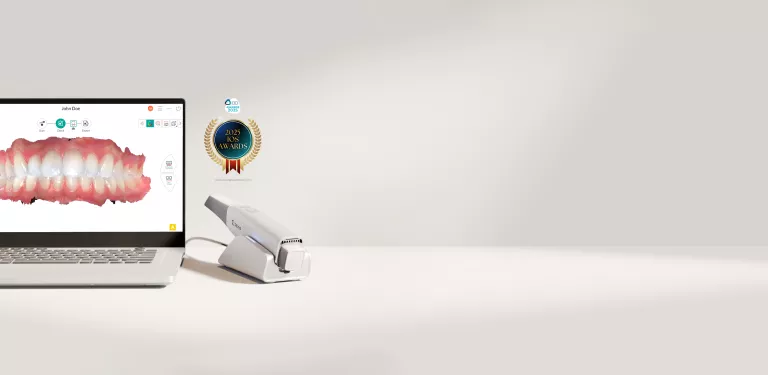
Standfirst: DEXIS Imprevo combines a 40-frame-per-second capture rate, 25 mm depth of field and dual-sensor imaging with IS ScanFlow 2.0. The specifications are substantial, but buyers should separate image-acquisition claims from clinical accuracy—and price the computer, software, batteries and service around the scanner.
DEXIS has entered the premium wireless intraoral-scanner contest with Imprevo, a new handpiece powered by IS ScanFlow 2.0 and designed to connect scanning with the company’s broader imaging ecosystem.
The headline numbers are easy to remember: 40 frames per second, a 25 mm depth of field, a dual-sensor optical system and Wi-Fi 6 connectivity. The scanner is also 20% slimmer than its predecessor, according to DEXIS, and adds a smaller universal tip, an LED status ring and gesture control.
Those are meaningful hardware changes. They do not, on their own, establish clinical accuracy or a return on investment.
The more useful question is whether Imprevo produces consistently usable data in a practice’s actual restorative, orthodontic and implant workflows—and what infrastructure must be bought to achieve that result.
What is actually new?
Imprevo is not a cordless version of the existing IS 3800W. DEXIS says it was designed as a new scanner and pairs it with the second generation of IS ScanFlow.
The optical system combines a 447 nm laser diode with white LED illumination and dual image sensors. The manufacturer says this improves geometry and texture capture, particularly around margins and in narrow interproximal spaces.
The published technical specification lists:
- 16 × 14 mm field of view;
- a working-depth range of -2 to 23 mm, described commercially as 25 mm depth of field;
- 40 FPS capture;
- 297 g handpiece weight including the battery;
- 257 × 36 × 45 mm dimensions without the cable;
- 5 GHz Wi-Fi 6 (802.11ax) communication;
- inductive charging and a magnetically installed battery;
- STL, PLY and OBJ export, plus xOrder for DWOS and Dentalproject for exocad.
The tip can be autoclaved for up to 160 cycles using the listed four-minute process at 134°C, or up to 100 cycles using the listed 18-minute process. That distinction matters when a practice calculates consumable cost and instrument turnaround.
40 FPS is a throughput claim—not an accuracy result
A higher frame rate can give the reconstruction software more overlapping observations as the operator moves the scanner. It can also make the live view feel smoother and reduce the chance that a rapid hand movement creates a gap.
However, frame rate is only one part of the acquisition chain. Optical geometry, exposure, calibration, surface reflectivity, filtering, stitching and the operator’s scan path all influence the final mesh.
DEXIS uses an asterisk beside several performance claims on its product page. The public page does not provide a peer-reviewed Imprevo validation study showing trueness and precision for crowns, bridges, dentate full arches or full-arch implant cases.
As of July 23, 2026, Digital Dentistry Daily did not identify a peer-reviewed accuracy study focused specifically on Imprevo.
That does not mean the scanner is inaccurate. It means buyers should not translate “40 FPS” into a micrometre value that the manufacturer has not published.
The 25 mm depth of field needs a clinical demonstration
A larger depth of field could help capture deep preparations and interproximal surfaces without requiring the tip to remain at one exact distance. This is particularly appealing when access is restricted.
But depth of field describes the range over which the imaging system can acquire usable information. It does not guarantee that soft tissue, blood, saliva or a subgingival margin becomes visible to the scanner.
Published research on other intraoral scanners has shown that scanner choice and preparation geometry can affect how much subgingival surface is recorded. The practical limitation remains optical access. If the camera cannot see a margin, software cannot reconstruct the hidden surface reliably.
A useful demonstration should therefore include the practice’s difficult cases—not only a dry, fully dentate training model.
Ask the representative to scan:
- a posterior preparation with limited opening;
- a deep interproximal box;
- a long-span restorative case;
- a dentate full arch;
- the implant workflow the practice intends to use.
Send the resulting files to the real laboratory and ask whether margin readability and mesh quality are better, equivalent or worse than current scans.
Wireless performance depends on the room around it
Imprevo is wireless-only. DEXIS specifies 5 GHz Wi-Fi 6 communication between the scanner and its computer.
That removes a cable from the operator’s hand, but it makes local radio performance part of the clinical system. Walls, distance, competing networks and the location of the workstation can affect a wireless workflow even when the scanner itself is functioning correctly.
Research involving other wireless scanners suggests that wireless devices can produce high-quality scans, but performance varies by scanner and clinical situation. A 2025 in-vitro study of four scanners found that scanner model, prosthesis configuration and their interaction affected accuracy. A separate 2025 study found that battery level and transmission distance could affect aspects of complete-arch scanning with the tested wireless systems.
Neither study evaluated Imprevo, so neither validates or discredits it. Together they support a simple procurement rule: test the scanner at the same distances and in the same rooms where it will be used.
The workstation specification is unusually important
The computer can easily become the hidden purchase.
DEXIS recommends Windows 11 Professional or Enterprise, a 13th-generation Intel Core i7 processor, 32 GB of RAM and a discrete GPU. The listed laptop options include an NVIDIA GeForce RTX 4080 with 12 GB of memory or RTX 4000 Ada; desktop recommendations include an RTX 4070 or RTX 5070 with 12 GB.
Those are high-end graphics requirements for a dental acquisition station. A practice with an older imaging laptop should not assume the scanner can be added without a computer replacement.
The total quote should identify:
- the exact computer model and GPU;
- whether the computer is supplied, validated and supported by the dealer;
- docking, display and cart costs;
- Wi-Fi requirements and any network work;
- spare batteries and charging hardware;
- IS ScanFlow licensing and update terms;
- cloud-storage or sharing fees;
- warranty duration, loan equipment and response time.
Comparing scanner handpiece prices without those items can produce a misleading purchasing decision.
IS ScanFlow 2.0 may be the stronger differentiator
The scanner runs through IS ScanFlow 2.0, which handles acquisition, mesh refinement and prescription creation. DEXIS promotes AI-assisted processing intended to remove artefacts, reduce rescanning and improve the final impression.
The workflow supports common open file formats and direct exocad and DWOS routes. DEXIS IS Connect enables cloud sharing with laboratories, while integration with DTX Studio Clinic can combine intraoral scans with 2D and CBCT imaging.
That creates two possible value propositions.
For a practice already using DEXIS or DTX Studio, Imprevo can reduce transfers between separate applications and centralize patient imaging. For a practice built around another imaging platform, the open exports preserve a route to external laboratories, but some of the product’s most distinctive benefits may remain inside the DEXIS environment.
“Open” therefore needs to be tested at workflow level. The ability to export STL is valuable, but STL does not carry colour texture. PLY and OBJ can preserve richer visual data, while proprietary prescription and case-status information may depend on the receiving platform.
Before purchase, send each intended file type to every important laboratory and confirm what information survives the transfer.
Gesture control is useful only if teams use it
Imprevo can rotate the model on screen through hand gestures, allowing an operator to inspect a scan without touching the computer.
The potential infection-control and ergonomic benefit is obvious. Its actual value depends on recognition reliability, room layout and whether the gesture is faster than the team’s established method.
The same applies to the LED ring and universal tip. These are thoughtful interface details, but a purchasing decision should weight them below mesh quality, software stability, training and service.
What remains unproven publicly
DEXIS provides detailed specifications, clinician testimonials and commercial claims. Public evidence is thinner in several areas:
- scanner-specific trueness and precision across clinical indications;
- repeatability across different operators;
- full-arch implant performance with different scan-body systems;
- battery endurance under a full clinical schedule;
- wireless reliability in congested practice networks;
- remakes or adjustment rates compared with the previous DEXIS generation;
- time saved from scan start through laboratory acceptance.
Testimonials can identify useful hypotheses, but they are not controlled comparisons. An award is recognition, not clinical validation.
Practices considering Imprevo should request the manufacturer’s validation reports and ask which claims were measured internally, independently or in peer-reviewed research.
Who should shortlist it?
Imprevo is a logical candidate for a practice that wants a premium wireless scanner and already uses DEXIS imaging, DTX Studio Clinic or IS Connect.
It may also appeal to clinicians who routinely struggle with posterior access and want to evaluate whether the smaller tip and greater specified depth of field improve margin capture.
The case is less automatic for a practice whose priorities are a low-cost workstation, a wired fallback or an entirely platform-neutral software stack. At 297 g including the battery, Imprevo should also be compared in hand with lighter competitors over a complete scan—not judged from a short demonstration.
A disciplined buying test
Run a one-week evaluation using normal staff and normal cases. Record:
- acquisition time;
- number and location of rescans;
- processing and upload time;
- laboratory requests for new data;
- battery changes;
- connection interruptions;
- user comfort;
- file-transfer success;
- total time from opening the case to laboratory acceptance.
The scanner that wins a showroom race may not win this test.
The bottom line
DEXIS Imprevo is a substantial hardware update. Its 40 FPS acquisition, dual-sensor optics, 25 mm depth-of-field specification, smaller tip and integrated wireless design make it a credible premium scanner.
The strongest reason to buy it may be the complete DEXIS workflow rather than any single specification.
The cautious conclusion is equally clear: frame rate is not accuracy, depth of field is not subgingival vision, and a wireless handpiece is not a standalone purchase. Imprevo deserves a serious clinical trial—but the trial should include the workstation, network, software, laboratory connection and support contract that determine whether the scanner succeeds after the demonstration ends.
Key specifications
| Item | Published specification |
|---|---|
| Capture rate | 40 FPS |
| Field of view | 16 × 14 mm |
| Depth of field | -2 to 23 mm |
| Weight | 297 g including battery |
| Connection | 5 GHz Wi-Fi 6, wireless only |
| Illumination | 447 nm laser diode and white LED |
| Export formats | STL, PLY, OBJ, xOrder for DWOS, Dentalproject for exocad |
| Tip reprocessing | Up to 160 standard cycles or 100 extended cycles |
| Recommended RAM | 32 GB |
| Recommended OS | Windows 11 Professional/Enterprise |
Sources
- DEXIS, “DEXIS Imprevo product page.” Accessed July 23, 2026.
- DEXIS, “DEXIS unveils Imprevo scanner, powered by IS ScanFlow innovation.” September 16, 2025. Accessed July 23, 2026.
- DEXIS, “Imprevo Instructions for Use.” Accessed July 23, 2026.
- Dönmez MB, Çakmak G, et al. “Scan accuracy of recently introduced wireless intraoral scanners in different fixed partial denture situations.” Journal of Dentistry. 2025;153:105558.
- Schlenz MA, Chillemi L, Wöstmann B. “Clinical study on the accuracy of wireless intraoral scanners for digital full arch impressions of dentate arches.” Journal of Dentistry. 2025;163:106132.
- Guo YQ, Lin KJ, Wang ZE, Yu H. “Effects of battery levels and transmission distances on the accuracy and scan time of wireless intraoral scanners in complete-arch scans.” Journal of Dentistry. 2025;161:105975.
Image credit
DEXIS, official Imprevo product image retrieved from the company’s product page. Editorial use remains subject to DEXIS media terms.
Editorial disclosure
This article analyzes manufacturer documentation and peer-reviewed research. It was independently written, was not sponsored and contains no affiliate links. Digital Dentistry Daily had not independently tested DEXIS Imprevo at the time of writing. Product names and trademarks belong to their respective owners.
About the author