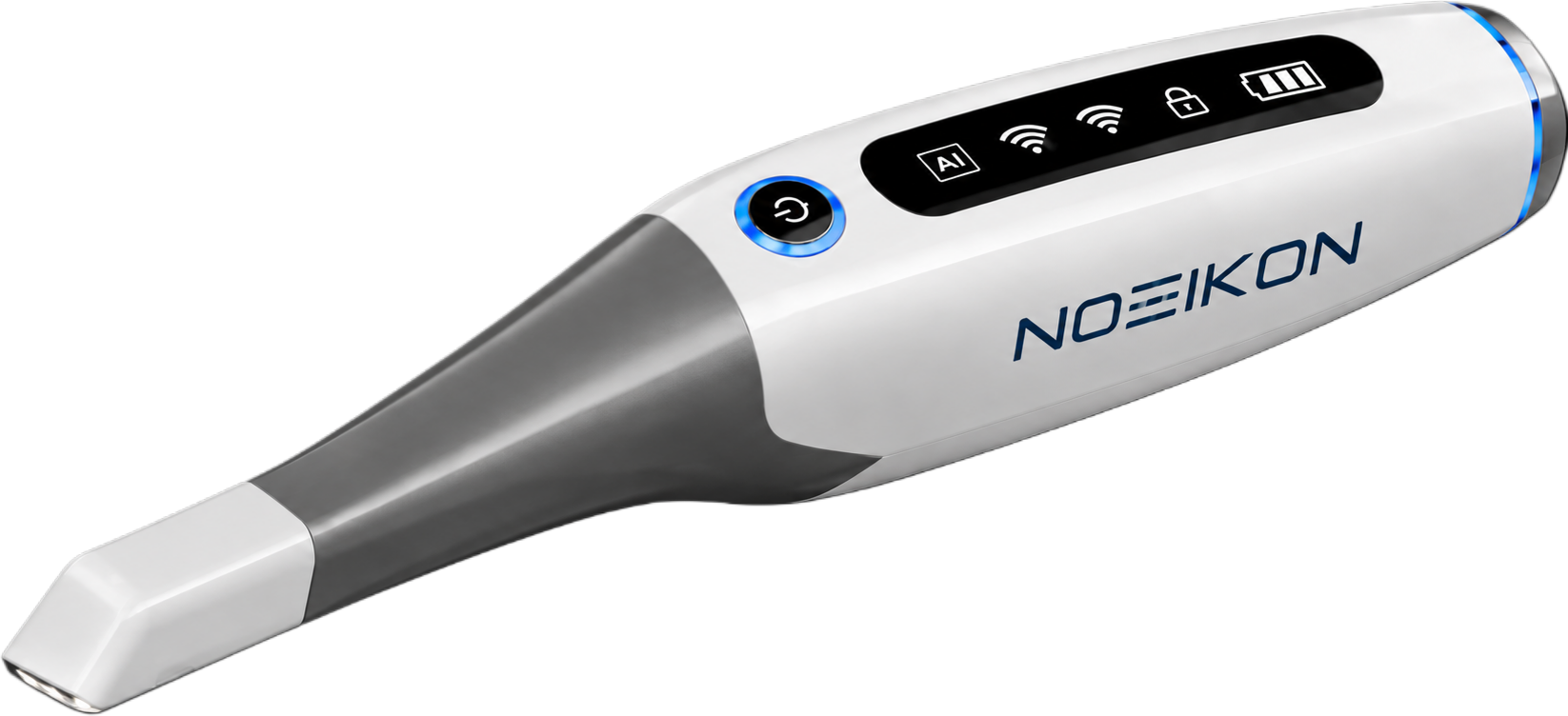
There is no shortage of AI language in digital dentistry right now, but a newly surfaced scanner project called Noeikon is making a more specific claim than most. On its official site, the company describes its system as the only intraoral scanner with AI inside the wand itself, positioning onboard diagnostic processing—not just cloud-connected analysis—as the core differentiator.
That framing matters because most current dental AI workflows still depend on external computation, whether on a chairside workstation or in the cloud. Noeikon is arguing that the next real leap is not simply better scanning, but moving diagnostic intelligence directly into the handpiece.
A different product story than the usual scanner launch
According to Noeikon’s official materials, the platform centers on onboard edge AI for chairside detection of caries, calculus, and periodontal findings. The company also highlights a fully offline architecture, sub-500 millisecond inference latency, and a design approach intended to keep raw image data from leaving the device during analysis.
If that architecture holds up in real clinical workflows, it could shift the conversation around scanner intelligence in three important ways: speed, privacy surface area, and system dependency. In simple terms, the promise is that clinicians would not have to wait for a network round trip, rely on a separate compute environment, or expand the data path every time an AI-assisted finding is generated.
Why this matters clinically
For everyday restorative and hygiene workflows, AI inside the scanner could make findings feel more native to the scan itself rather than appended to it afterward. That distinction may sound subtle, but it changes the user experience significantly. The closer guidance sits to the live scan, the more likely it is to influence capture quality, soft-tissue management, rescanning decisions, and communication with patients while they are still in the chair.
Noeikon also claims compatibility ambitions beyond image capture. Its site describes a structured output layer aimed at practice-management and clinical software ecosystems, naming common platforms such as Dentrix, Eaglesoft, Curve, Open Dental, and HL7 FHIR-style interoperability pathways. If those integrations mature, the platform could become more than a hardware story.
The most interesting part may be the architecture—not just the scanner
What makes this launch especially interesting is that Noeikon is not presenting itself like a conventional volume-shipment scanner announcement. The site repeatedly frames the technology as a patent-pending platform and a licensing opportunity for intraoral scanner manufacturers, dental AI companies, and software vendors.
That is an important nuance. At this stage, the bigger story may be the architecture and commercialization model rather than immediate head-to-head competition with established intraoral scanners already embedded in daily practice. In other words, Noeikon may be less a straightforward new box to buy tomorrow and more a signal of where scanner design could be heading next.
What we would want to see next
As with any early launch, the key questions now move from claims to validation. The market will want to see how the system performs on true full-arch scanning, reflective surfaces, edentulous spans, implant scanbody workflows, and repeated day-to-day sterilization cycles. Published evidence, regulatory milestones, and real-world clinical demonstrations will ultimately determine whether onboard AI becomes a durable category shift or remains a compelling concept.
Still, as a directional launch, Noeikon deserves attention. In a market where many scanner announcements now compete on ergonomics, ecosystem ties, or incremental software gains, this one stands out by challenging where diagnostic intelligence should actually live.
Source: Official Noeikon launch materials and product website, accessed July 28, 2026.
About the author