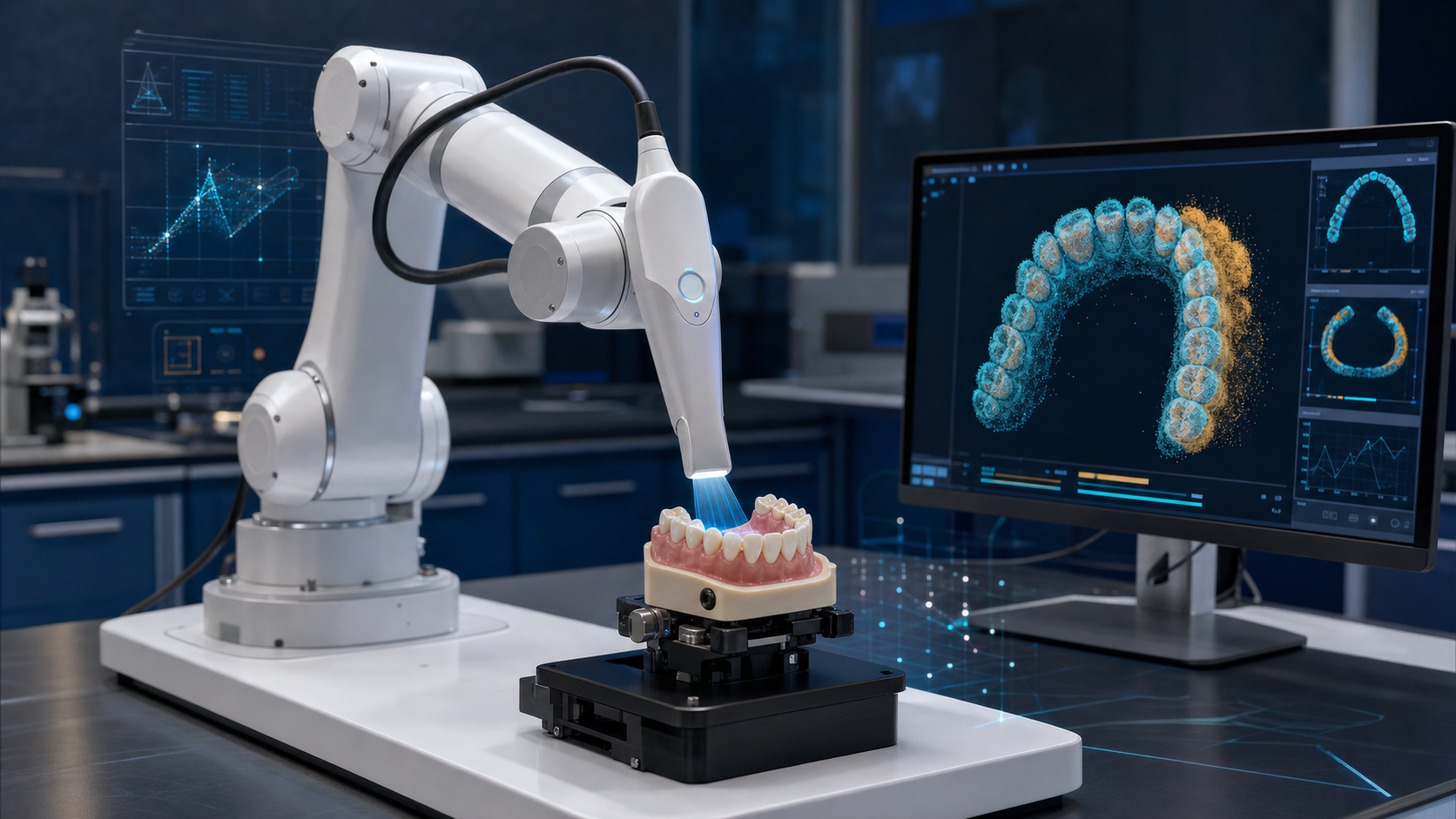
Standfirst: A new reinforcement-learning system chooses scanner movements from a growing three-dimensional memory of the dental arch. RobOralScan reached 92.58% average coverage and completed 8 of 10 evaluation episodes, then transferred to a physical robot without additional training. The work is a robotics preprint, however—not a patient study or a market-ready dental device.
Researchers have presented RobOralScan, a reinforcement-learning pipeline designed to let a robot decide how to move an intraoral scanner around a dental arch.
The project addresses a real limitation of digital impressions. A scanner records only a narrow field at each instant, while the operator must maintain tracking, expose difficult surfaces and recognize missing data. Full-arch scanning is therefore not simply a camera task. It is a continuous decision problem.
RobOralScan turns that problem into closed-loop robotic control. Instead of following one fixed route, the system accumulates scan history, identifies insufficiently observed regions and chooses the scanner’s next relative movement.
In simulation, the authors report 92.58% average coverage, 88.45% lower-tail per-tooth coverage, a Chamfer Distance of 0.00838 and successful completion in 8 of 10 evaluation episodes. They also report a zero-shot transfer experiment on a physical robot-scanner setup.
The results are technically interesting. They do not mean a robot is ready to scan patients.
Why automated scanning is harder than replaying a path
A scripted robot can repeat a trajectory precisely. That is not enough for reliable intraoral scanning.
Every mouth presents different tooth positions, arch forms, restorations and missing teeth. The operator also encounters saliva, reflective surfaces, soft-tissue movement, tongue interference and restricted access. A fixed path cannot know whether the scanner temporarily lost tracking or failed to capture a distal surface.
RobOralScan is designed to react to what has actually been observed.
Its policy receives accumulated geometric information and robot proprioception. It then outputs relative scanner motion in six degrees of freedom. As scanning continues, the observation is updated and the next movement can change.
That feedback loop is the important idea. Automation becomes a process of measuring coverage, acting and measuring again rather than replaying a memorized sequence.
A three-state memory of the arch
The system represents the workspace as a volumetric grid. Each region is categorized as:
- occupied, where geometry has been observed;
- free, where the scanner’s viewing ray has passed without detecting a surface;
- unknown, where information remains insufficient.
This gives the policy a memory of both captured surfaces and unexplored space.
The distinction between free and unknown is valuable. A simple point cloud shows where data exists, but it does not explicitly explain whether an empty region has been inspected or never viewed. The tri-state representation provides a stronger basis for selecting the next scan direction.
The approach resembles an exploration problem in mobile robotics: build a map while choosing viewpoints that reveal useful new information.
Why tooth-wise coverage matters
A high average coverage score can hide a clinically important failure.
A system might record occlusal and buccal surfaces very well while leaving a small number of posterior or interproximal regions incomplete. The global percentage still looks strong even though one poorly captured preparation could make the scan unusable.
RobOralScan therefore includes tooth-wise coverage learning. Its reward design encourages the policy to improve global reconstruction while reducing uneven coverage across individual teeth.
The authors report a lower-tail per-tooth coverage of 88.45%. This metric focuses attention on the less-completely scanned teeth rather than only the mean.
That is a sensible direction for dental automation. Clinical acceptance should ultimately become even more task-specific. A crown workflow may prioritize the preparation margin and adjacent contacts, while an orthodontic record may prioritize complete crown surfaces and gingival boundaries.
Coverage is necessary, but not every missing square millimetre has equal clinical importance.
What the reported numbers mean
The paper reports four principal evaluation results:
| Metric | RobOralScan result |
|---|---|
| Average coverage | 92.58% |
| Lower-tail per-tooth coverage | 88.45% |
| Chamfer Distance | 0.00838 |
| Completed evaluation episodes | 8 of 10 |
Coverage describes how much target geometry was observed under the study’s definition. Chamfer Distance measures geometric separation between reconstructed and reference point sets.
Neither number can be translated directly into crown fit, full-arch trueness in micrometres or clinical acceptability. Those outcomes require a defined physical scale, a dental metrology protocol and comparison with clinically relevant reference data.
The 8-of-10 completion result is also important for the opposite reason: two episodes did not meet the scan criterion.
An 80% experimental success rate may demonstrate progress in robotics. It would be unacceptable as an unsupervised clinical completion rate. A clinical system would need reliable failure detection, safe retreat, operator takeover and evidence that it never mistakes an incomplete scan for an acceptable one.
Simulation is doing most of the evidentiary work
Reinforcement learning typically requires many interactions. Training those interactions in a patient would be impossible and unsafe, so the policy learns in simulation.
Simulation allows the researchers to vary geometry, repeat trials and penalize poor movements without clinical risk. It also creates a gap between the training world and physical reality.
Real scanner behaviour includes optical noise, latency, dropped tracking, surface reflectivity, calibration variation and software-dependent mesh reconstruction. Real patients add movement, soft tissue, saliva, anxiety and anatomical constraints that a dental model cannot reproduce fully.
The authors’ zero-shot sim-to-real experiment is therefore meaningful: the learned policy was transferred to a physical robot-scanner setup without additional task-specific training.
It is still a feasibility demonstration, not an intraoral patient trial.
The safety problem is larger than collision avoidance
A robotic scanner operating near teeth and soft tissue must manage several kinds of safety.
Mechanical safety
The system needs limits on force, speed, acceleration and reachable space. It must respond safely to unexpected patient movement and allow immediate withdrawal.
Optical and thermal safety
The scanner must remain within its intended operating conditions, including illumination, heat and hygiene requirements.
Reconstruction safety
The system must recognize missing or unreliable data. A collision-free scan can still be clinically unsafe if the resulting model is incomplete but accepted.
Human-factors safety
The patient and dental team need clear control over starting, pausing and stopping the procedure. Automation should not obscure responsibility for verifying the record.
The preprint is focused on active scanning and reconstruction coverage. It does not establish this full clinical safety case.
A robot arm is not yet a dental product
RobOralScan should be understood as a research pipeline rather than a purchasable scanner.
Moving toward clinical use would require:
- hardware designed for chairside space and infection control;
- validated force and collision sensing;
- a scanner interface that exposes reliable real-time data;
- training across substantially more anatomical variation;
- detection of restorations, edentulous areas and mobile tissue;
- task-specific completion criteria;
- supervised and then clinical trials;
- regulatory review of the integrated system.
Economics also matter. A collaborative robot, scanner, mounting system, computing hardware, maintenance and staff training would need to provide value beyond a trained assistant or clinician.
The first viable market may not be routine chairside use. Controlled laboratory scanning, training simulators and standardized data-acquisition research could present lower-risk environments.
What manufacturers should learn now
The most transferable contribution may be software rather than the robot itself.
Current intraoral scanners already display missing-data maps and guide operators back to incomplete regions. A geometric-memory policy could extend that guidance by recommending the next best motion or automatically assessing whether each tooth has sufficient task-specific coverage.
Near-term applications could include:
- smarter on-screen scan arrows;
- objective completion checks;
- operator training with trajectory feedback;
- automated quality assurance before case submission;
- semi-autonomous movement under continuous human control.
These steps could reduce operator variability without placing a general-purpose robot beside the patient.
What evidence should come next
The next studies should separate three questions.
First, can the policy generalize to unseen anatomies, edentulous regions, preparations, implants and restorations?
Second, does physical robotic acquisition produce models that meet established trueness and precision requirements compared with manual scanning?
Third, can the integrated system operate safely and acceptably with patients?
A useful progression would include:
- expanded model testing with multiple scanner technologies;
- standardized dental metrology against high-accuracy reference scans;
- deliberate tracking-loss and obstruction tests;
- force-limited experiments with realistic soft-tissue phantoms;
- supervised human-factor studies;
- carefully controlled clinical feasibility trials.
Coverage and Chamfer Distance should then be supplemented with margin capture, interarch accuracy, scan time, failure recovery, patient comfort and restoration outcomes.
The bottom line
RobOralScan is an important proof of concept because it reframes intraoral scanning as active perception. The robot does not merely follow a path; it uses accumulated geometry to decide what to inspect next.
The reported 92.58% coverage and zero-shot transfer to physical hardware justify further research. The 8-of-10 completion rate equally demonstrates how far the system remains from unsupervised clinical use.
This is not evidence that dentists or assistants are about to be replaced. It is evidence that scan guidance can become more adaptive, measurable and tooth-aware.
The near-term impact may arrive as smarter assistance inside conventional scanners. Fully autonomous chairside scanning will require a much larger body of metrology, safety and patient evidence than one robotics preprint can provide.
Sources
- Lee J, Yun H, Kim S, Baek G, Moon S, Hwang S, Im S. “RobOralScan: Learning Active Intraoral Scanning for Robotic Dental Reconstruction.” arXiv:2606.26955, submitted June 25, 2026.
- Revilla-León M, et al. “Factors affecting the accuracy of digital intraoral scans: A systematic review.” Journal of Prosthodontics. 2023.
- Schlenz MA, Chillemi L, Wöstmann B. “Clinical study on the accuracy of wireless intraoral scanners for digital full arch impressions of dentate arches.” Journal of Dentistry. 2025;163:106132.
Image credit
Original editorial visualization generated for Digital Dentistry Daily. The image is illustrative and does not reproduce the RobOralScan apparatus or experimental results.
Editorial disclosure
This article analyzes a publicly available research preprint and related literature. It was independently written, was not sponsored and contains no affiliate links. RobOralScan had not been independently tested by Digital Dentistry Daily. The featured image is an AI-generated editorial visualization.
About the author