Standfirst: The three-day Digital Journey Bucharest congress will bring an international faculty to Romania on September 25–27, 2026, with a programme spanning jaw-motion tracking, AI-assisted diagnostics, implant rehabilitation, orthodontics and CAD/CAM. Its most interesting proposition is not any single technology, but the attempt to connect digital records with functional treatment decisions.
Bucharest will host a new international meeting at the intersection of digital dentistry, implantology and functional rehabilitation this September.
Digital Journey Bucharest 2026 is scheduled for September 25–27 at NORD Events Center by Globalworth. Dental Depot is organizing the congress in partnership with ICCMO Balkans, the regional section of the International College of Cranio-Mandibular Orthopedics.
The organizers advertise more than 19 speakers, three days of lectures, live cases and workshops, and participation from more than 20 countries. The public programme is organized around five broad tracks: neuromuscular dentistry, digital diagnostics, implant rehabilitation, orthodontics and prosthetic dentistry.
Those subjects are often presented separately. The more ambitious idea behind Digital Journey is to show how they can form a single clinical record and treatment workflow—from an intraoral scan, CBCT and facial data to jaw-motion capture, virtual articulation, implant planning and the definitive restoration.
That makes the congress worth watching. It also makes evidence, interoperability and reproducibility more important than the novelty of the equipment on stage.
What is on the programme
The currently announced faculty combines clinicians, dental technicians and an engineering speaker from Europe, the United States, Australia, India and the Balkans.
The programme page lists topics including:
- TENS-assisted neuromuscular bite registration for temporomandibular disorders and orthodontic diagnosis;
- digital cranio-mandibular diagnostics beyond static occlusion;
- digital measurement of mandibular trajectories;
- the use of facial muscles and expressions in functional assessment;
- motion capture and the creation of a “dental twin”;
- 4D digital dentistry workflows;
- digital orthodontic planning;
- 3D-printed provisional implant restorations;
- full-arch FP1 rehabilitation;
- digital workflows for edentulous patients;
- one-piece implant concepts;
- complete dentures, veneers and contemporary laboratory techniques;
- accuracy losses across a connected digital workflow.
The organizers describe the first two days as scientific lectures and live cases, with the final day adding workshops focused on implant rehabilitation, guided surgery, full-arch prosthetics and workflow integration. A complete session-by-session timetable had not been published on the congress page when Digital Dentistry Daily reviewed it on July 23.
The real theme is data connection
Digital dentistry meetings frequently demonstrate scanners, software and manufacturing systems as individual products. Digital Journey is positioning the clinical problem differently: how can several data sources describe the same patient and remain useful throughout treatment?
A dynamic virtual patient may combine an intraoral scan, facial scan, CBCT volume, recorded jaw position and real-time mandibular movement. In principle, the model can help a restorative or orthodontic team evaluate anatomy, aesthetics and function in a shared digital environment.
The difficult part is not collecting more files. It is registering them accurately, preserving their coordinate relationships and translating the combined model into a better clinical decision.
A 2023 systematic review of four-dimensional virtual patients found that combining dynamic and static dental data was feasible, but the evidence base was small: the 27 included reports covered only 75 patients and three phantoms, and few studies had a low risk of bias. Roughly half of the studies established acceptable accuracy; the remainder primarily demonstrated feasibility.
A newer systematic review published in 2026 reached a similar balance. Optical jaw-tracking systems generally showed better precision than conventional approaches and potential clinical value, but the authors found high risk of bias, small samples, limited long-term evaluation and inconsistent protocols.
That does not make jaw tracking clinically irrelevant. It means that a strong congress presentation should distinguish between a technically impressive recording, a repeatable measurement and an intervention shown to improve patient outcomes.
Functional dentistry claims deserve precise questions
The ICCMO connection gives the Bucharest programme an unusually strong focus on neuromuscular diagnostics, TENS-assisted muscle relaxation and physiologic occlusion.
These presentations may be particularly useful if they make their clinical assumptions testable. Attendees should listen for the patient-selection criteria, reference standards, repeatability data and treatment endpoints behind each protocol.
Useful questions include:
- How repeatable is the recorded mandibular position on different days?
- Which part of the result depends on the operator or device?
- How is a clinically meaningful change separated from measurement noise?
- Is the proposed position used for diagnosis, reversible testing or irreversible treatment?
- What comparison group supports the claimed benefit?
- Are pain, function, restoration survival and patient-reported outcomes measured?
- Can the workflow be reproduced with another manufacturer’s hardware and software?
This scrutiny matters because jaw movement is influenced by posture, temporomandibular disorders, previous orthodontic treatment, shortened dental arches and other biological variables. A systematic review of digital jaw-movement analysis reported device accuracies ranging from approximately 50 to 330 micrometres, while more than half of the included studies were rated below moderate certainty.
The most valuable sessions in Bucharest will therefore be those that expose the complete protocol—including its limitations—rather than presenting a digital visualization as proof of a diagnosis.
Full-arch rehabilitation will be another test case
Implant rehabilitation is the congress’s second major clinical pillar. Announced lectures cover guided workflows, printed provisionals, full-arch FP1 cases, edentulous patients and the accuracy losses that can occur between data acquisition and manufacturing.
That is a timely focus. Complete-arch implant scanning remains one of the areas where a smooth software demonstration can conceal clinically important error.
A 2026 systematic review found that scan-body aids may reduce linear deviation in complete-arch intraoral scans, but the benefit was system-dependent and evidence for improvements in angular deviation and precision was inconsistent. Other recent reviews have found photogrammetry more accurate than intraoral scanning for some complete-arch implant measurements.
Congress demonstrations should therefore disclose the implant distribution, reference method, scan bodies, scanning strategy, software version and fit-verification procedure. “Fully digital” describes a route through the workflow; it does not, by itself, establish the accuracy of the final prosthesis.
Why Bucharest is a credible regional setting
The meeting is scheduled for NORD Events Center in Bucharest’s northern business district. Globalworth describes the conference centre as an approximately 1,850-square-metre venue with integrated audio, video and lighting infrastructure. Its location close to the Pipera metro station should make it accessible for local delegates and international visitors staying in the northern part of the city.
Romania already has an active dental education and technology market, while Bucharest is well positioned for clinicians from Central Europe, the Balkans, Türkiye and the Middle East. The announced faculty reflects that geographic bridge.
The congress also follows ICCMO activity in Dubai earlier in 2026. For the organizers, Bucharest is being presented as the next regional chapter in a broader discussion about functional and digital dentistry.
Details that still need clarification
Prospective delegates should check the organizer’s website before arranging travel.
The dedicated congress page states September 25–27, 2026, and gives daily themes for those dates. A separate Dental Depot course listing contains a conflicting reference to September 24–26 in its description, even though the time slots on the same listing begin on September 25. The dedicated congress page should be treated as the current event source, but the discrepancy should be corrected by the organizer.
At the time of review, the public congress page did not provide:
- a detailed timetable with session lengths;
- a final list of all advertised speakers;
- ticket prices and cancellation terms;
- continuing-education accreditation details;
- workshop capacity or eligibility;
- a full sponsor and exhibitor list;
- the language and translation arrangements for each session.
Those are material details, especially for clinicians travelling from outside Romania. Delegates should confirm them directly before purchasing non-refundable transport or accommodation.
What would make the congress succeed
Digital Journey Bucharest 2026 has the ingredients for a distinctive meeting: an international faculty, a technically equipped venue and a programme that crosses the usual boundaries between prosthodontics, orthodontics, implantology and functional diagnosis.
Its success should not be judged by the number of technologies connected during a live demonstration.
The more useful measure will be whether attendees leave understanding where each data set comes from, how accurately it can be registered, which decisions it can support and where the scientific evidence remains incomplete.
If the congress delivers that level of transparency, Bucharest could host a valuable regional conversation about the next phase of digital dentistry: not more isolated devices, but more reliable connections between data, clinical reasoning and patient outcomes.
Event information
| Detail | Published information |
|---|---|
| Event | Digital Journey Bucharest 2026 |
| Dates | September 25–27, 2026 |
| Venue | NORD Events Center by Globalworth |
| City | Bucharest, Romania |
| Organizer | Dental Depot |
| Partner | ICCMO Balkans |
| Format | Scientific lectures, live cases and workshops |
| Main tracks | Neuromuscular dentistry, digital diagnostics, implant rehabilitation, orthodontics and prosthetic dentistry |
| Event website | Digital Journey Bucharest 2026 |
Sources
- Dental Depot, “Digital Journey Bucharest 2026.” Event page. Accessed July 23, 2026.
- Dental Depot, “Courses.” Course calendar. Accessed July 23, 2026.
- Globalworth, “NORD Events Center by Globalworth.” Accessed July 23, 2026.
- Tafuri G, Santilli M, D’Addazio G, et al. “Jaw Tracking System in Digital Dentistry: A Systematic Review.” International Journal of Prosthodontics. Published online February 6, 2026.
- Farook TH, Rashid F, Alam MK, Dudley J. “Variables influencing the device-dependent approaches in digitally analysing jaw movement—a systematic review.” Clinical Oral Investigations. 2023;27(2):489–504.
- Yuan Y, Liu Q, Yang S, He W. “Four-Dimensional Superimposition Techniques to Compose Dental Dynamic Virtual Patients: A Systematic Review.” Journal of Functional Biomaterials. 2023;14(1):33.
- Pachiou A, Auderset FC, Jung RE, Zitzmann NU, Joda T. “Impact of prefabricated aids and auxiliary devices for scan bodies on the accuracy of intraoral scanning for full-arch implant impressions: A systematic review.” Journal of Prosthodontics. Published online April 20, 2026.
- Altalla H, Alhelou H, Karaduman F, Alawawda O, Bayindir F. “Comparative accuracy of photogrammetry and intraoral scanners in recordings for complete arch implant-supported prostheses: A systematic review and meta-analysis.” Journal of Prosthetic Dentistry. 2026;135(5):e60–e70.
Image credit
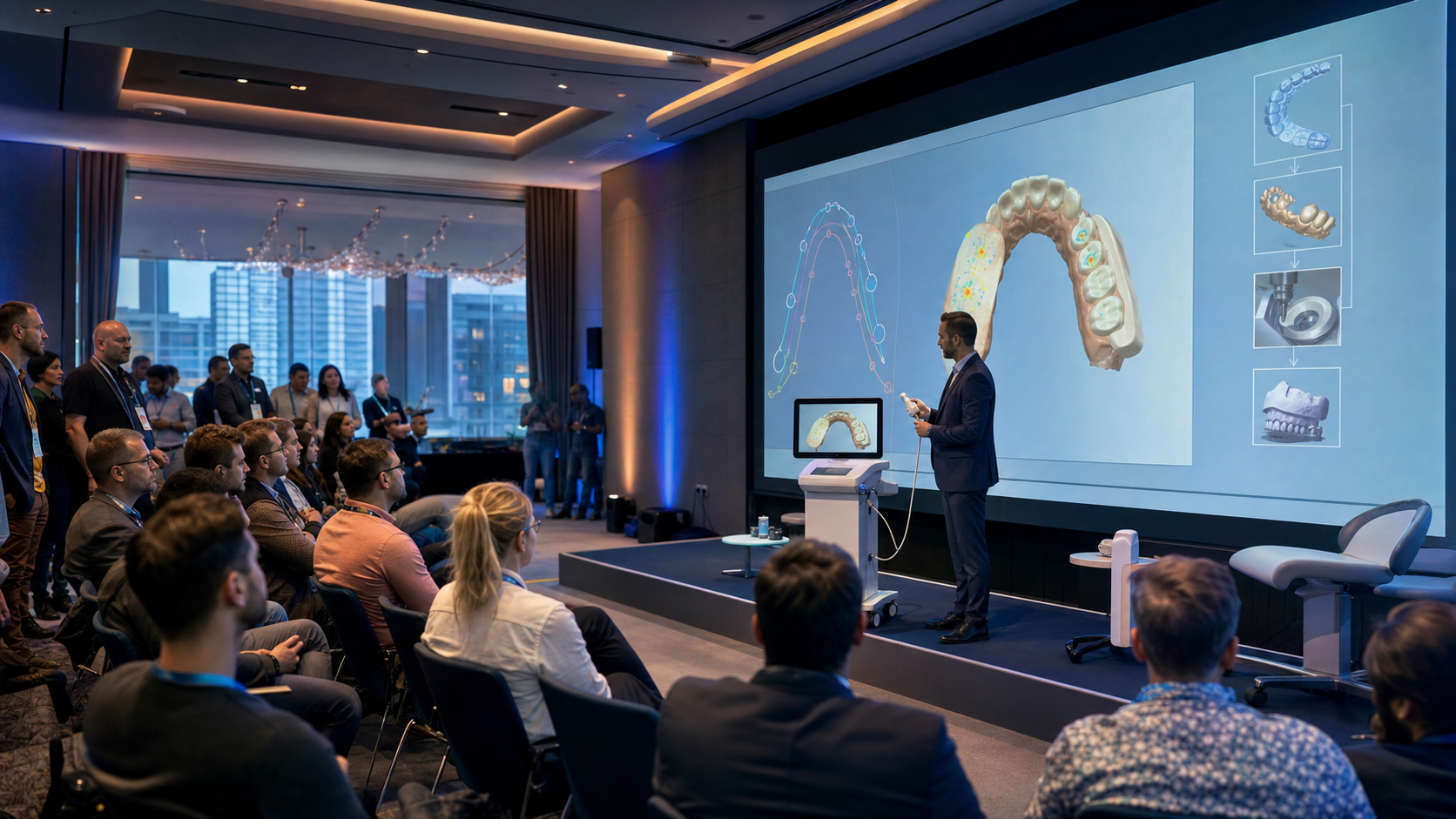
Digital Dentistry Daily, AI-generated editorial illustration. The image is conceptual and does not depict Digital Journey Bucharest 2026, its venue, faculty or attendees.
Editorial disclosure
This article was independently researched and written from organizer information, venue information and peer-reviewed literature. It was not sponsored, and Digital Dentistry Daily has no disclosed commercial relationship with the congress, Dental Depot, ICCMO Balkans or the speakers named in the programme. Event details may change; readers should verify current information with the organizer.
About the author