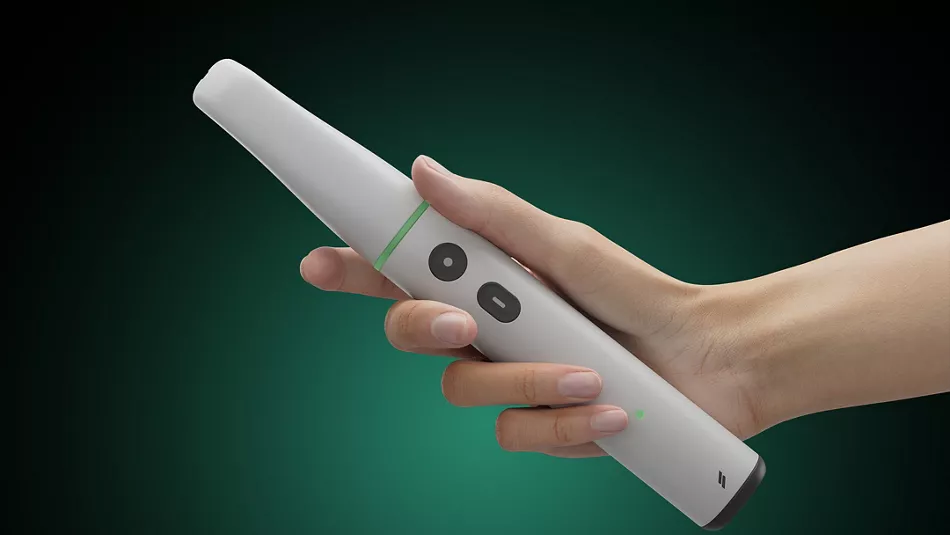
Standfirst: Straumann’s new wireless intraoral scanner combines a pen-style handpiece, calibration-free operation, long standby time and direct links to the company’s implant, orthodontic and chairside workflows. The hardware looks competitive, but buyers should examine the evidence, battery serviceability and the cost of the connected ecosystem.
Straumann has expanded its intraoral scanner portfolio with SIRIOS X3, a wireless device designed to sit between entry-level scanners and premium systems such as TRIOS 5 and TRIOS 6.
The scanner was introduced in the fourth quarter of 2025 and featured prominently in Straumann and ClearCorrect activity during 2026. Straumann Group says early demand has been strong and describes intraoral scanning as the entry point to its wider digital ecosystem.
That positioning reveals the more important story.
SIRIOS X3 is a piece of scanning hardware, but it is also a gateway to Straumann AXS, ClearCorrect, coDiagnostiX, Smile in a Box, UN!Q, EXACT and the Signature Midas chairside printing workflow. The purchase decision is therefore not only about scan speed, weight or battery life. It is about whether the surrounding platform matches the way a practice wants to plan, outsource and manufacture cases.
What has changed
Compared with the original SIRIOS, X3 moves to a slimmer pen-style handpiece and adds a smart action button, an LED guidance ring, faster charging and a dedicated full-arch workflow.
Straumann’s international product brochure lists:
| Feature | Published detail |
|---|---|
| Form factor | Wireless, pen-grip design |
| Published weight | 240 g in the product page and brochure |
| Tip configuration | One optimized tip size |
| Charging | 50% charge in 60 minutes |
| Active scanning | More than two hours on a full charge |
| Standby | Up to six months |
| Calibration | No manual calibration required |
| Scanner feedback | LED ring and intelligent action button |
| Cloud connection | Automatic upload and synchronization with Straumann AXS |
| File workflow | Import and export supported through an open-system proposition |
The SIRIOS portfolio comparison adds that the tip is validated for 180 sterilization cycles, active scanning can reach 150 minutes and the X3 uses an integrated long-life battery. It contrasts that with the original SIRIOS scanner’s removable battery, slower charging and shorter standby time.
Those are meaningful day-to-day improvements. They also create questions that a specification sheet cannot answer.
An integrated battery simplifies the handpiece and removes battery swapping. When capacity degrades, however, the scanner may need service rather than a quick battery replacement. A practice should request the expected battery lifespan, minimum retained capacity, replacement procedure, turnaround time and loan-scanner policy.
Straumann’s published weight is inconsistent
Buyers may notice that Straumann’s own pages do not agree on the handpiece weight.
The product page and international brochure state 240 g. The English SIRIOS portfolio comparison states 215 g. An independent hands-on review from the Institute of Digital Dentistry reports approximately 214 g.
The difference could reflect whether the measurement includes the tip or another component, but Straumann’s public pages do not explain it. The inconsistency is not large enough to determine whether the scanner succeeds clinically, yet it illustrates why purchasing teams should obtain a dated, region-specific technical sheet rather than relying on a marketing page.
The same principle applies to charging language. One source describes a 50% charge after 60 minutes; the portfolio comparison describes 0–80% in 60 minutes. The figures may come from different test conditions or revisions. A live demonstration should include the current hardware and software build that will actually be delivered.
The ecosystem is the differentiator
Many current scanners are fast, wireless and capable of exporting common file formats. Straumann’s strongest proposition is integration.
Scans can synchronize automatically to Straumann AXS, which the company describes as a cloud-based hub for open and modular workflows. From there, a practice can:
- submit cases to a laboratory;
- send implant-planning data to coDiagnostiX;
- connect orthodontic cases with ClearCorrect Dr. Portal;
- outsource guided-surgery cases through Smile in a Box;
- order design and manufacturing through Straumann UN!Q;
- use Straumann EXACT for full-arch restorative workflows;
- connect to Straumann Signature Midas by SprintRay for chairside printing.
For a practice already using Straumann implants, ClearCorrect or centralized Straumann services, fewer logins and less duplicate data entry could be more valuable than a small difference in scanning speed.
For a practice that works across several implant systems and independent laboratories, the important question is what “open” means in daily use. The product brochure says users can import and export files and integrate different hardware and software. Buyers should still verify which formats are available, whether export is unrestricted, which patient metadata travel with the scan and which advanced workflows remain exclusive to AXS.
Openness is not a checkbox. It is the ability to leave a platform without losing access to clinically useful data or adding avoidable friction.
Full-arch claims need protocol-level evidence
Straumann says SIRIOS X3 has automatic scanbody recognition, real-time scan-quality validation and a dedicated, validated workflow for full-arch implant restoration. The company particularly promotes the scanner in combination with Straumann EXACT.
Those claims deserve attention because full-arch implant scanning remains one of the hardest applications for an intraoral scanner.
Small stitching errors can accumulate across an edentulous arch. Scanbody geometry, inter-implant distance, soft-tissue movement, saliva, operator technique and the scanning path can all influence the final spatial relationship. A good dentate full-arch scan does not automatically establish accuracy for a completely edentulous implant case.
A 2026 systematic review of clinical studies found that prefabricated scanbody aids often reduced linear deviation and improved recognition, but the benefit was system-dependent. Improvements in angular deviation and precision were less consistent, and stereophotogrammetry frequently achieved higher accuracy on several complete-arch measures. The authors rated the evidence supporting auxiliary devices as low to moderate certainty.
That research did not evaluate SIRIOS X3 specifically. It does explain why a buyer should ask Straumann for the validation protocol behind the advertised workflow:
- How many implants and which arch configurations were tested?
- Was the work performed in vitro or in patients?
- Which scanbodies and auxiliary components were used?
- What reference scanner or measurement system established trueness?
- Were passive fit and clinical remakes assessed?
- Does validation apply only to Straumann EXACT components?
- Which software version and scanning strategy were used?
As of July 23, 2026, Digital Dentistry Daily did not identify a peer-reviewed comparative accuracy study focused specifically on SIRIOS X3. A detailed independent hands-on review described good scanning behaviour and accuracy in routine use, but it is not a peer-reviewed clinical validation study.
One tip simplifies inventory but reduces choice
SIRIOS X3 uses one optimized tip size. That can simplify ordering, sterilization records and staff training. Straumann says the tip provides an adequate field of view in posterior regions and the portfolio page lists 180 sterilization cycles.
A single tip is not automatically ideal for every patient. Limited opening, small arches and difficult posterior access may favour a smaller option, while a larger field of view can improve scanning efficiency in other situations.
Clinics should test the scanner on realistic cases, not only a cooperative typodont. They should also calculate the tip cost per validated cycle and confirm which autoclave parameters apply. The practical cost of a scanner includes consumables that are replaced hundreds of times after purchase.
Calibration-free does not mean quality-control-free
Straumann promotes SIRIOS X3 as calibration-free. Removing routine manual calibration is convenient and eliminates another accessory.
It does not eliminate the need for quality assurance.
A practice still needs a process for recognizing deteriorating scan behaviour, inspecting damaged tips, documenting software updates, testing connectivity and deciding when the device requires service. Calibration-free should mean that the manufacturer manages internal stability—not that every scan is assumed to be correct indefinitely.
Software changes also matter. Scanner performance is a combination of optics, image acquisition, stitching algorithms, post-processing and downstream workflow rules. Practices should record the software version used for clinically sensitive cases and review release notes before major updates.
Total cost is not visible from the product page
Straumann does not publish a universal SIRIOS X3 price on its international product page. An independent review reported a US price of $17,995 at the time of evaluation, but regional bundles, promotions and service contracts can change that figure.
A comparable quote should include:
- scanner hardware and charging equipment;
- workstation or laptop requirements;
- software licences;
- Straumann AXS storage and workflow fees;
- Excellence Club coverage after the included period;
- accidental-damage and express-replacement terms;
- replacement tips;
- battery service;
- training;
- interfaces to the practice-management system;
- costs for EXACT, UN!Q, Smile in a Box, ClearCorrect or chairside services.
The scanner may be competitively priced while the desired end-to-end workflow creates recurring costs. Conversely, an integrated service can reduce staff time, remakes and manual case transfer enough to justify a higher subscription. Only a complete workflow calculation can show the difference.
Who should consider it
SIRIOS X3 is most compelling for an implant-focused or multidisciplinary practice already invested in Straumann products.
The direct links to AXS, coDiagnostiX, ClearCorrect, Midas, EXACT and outsourced design services give that practice a clear path from capture to treatment. Straumann’s training, warranty and support network may also reduce implementation risk.
The decision is less automatic for a clinic whose priority is maximum third-party flexibility. SIRIOS X3 supports an open-system message, but its most differentiated workflows are designed around Straumann’s own platform and services.
New scanner buyers should compare it with alternatives using the same cases, laptop, network and staff. Existing scanner users should identify a specific bottleneck that X3 would remove. A lighter handpiece and faster charging are welcome, but they are not a business case by themselves.
Questions to ask before ordering
- What exactly is included in the installed price?
- Is the supplied handpiece 215 g or 240 g, and what components are included in that measurement?
- What are the battery replacement cost and expected service interval?
- Which file formats can be exported without additional fees?
- Which workflows require AXS or separate subscriptions?
- Can scans be used freely with any laboratory and implant-planning platform?
- Which full-arch indications have been independently or clinically validated?
- Are EXACT components required for the validated full-arch workflow?
- What computer, graphics hardware and network performance are recommended?
- What happens to local scanning and data access during an internet outage?
- How many sterilization cycles are supported under the clinic’s autoclave protocol?
- What loan and replacement coverage applies after the first year?
The bottom line
Straumann SIRIOS X3 has the ingredients of a competitive modern scanner: wireless pen-style ergonomics, long standby time, faster charging, calibration-free operation and a software platform that reaches from routine restorative work to full-arch implant and orthodontic workflows.
Its real advantage is not a single hardware specification. It is the ability to connect a scan with Straumann’s planning, manufacturing and treatment services.
That can be a powerful proposition for the right practice. It can also create dependency if the clinic does not verify export rights, subscription costs and service boundaries before purchase.
SIRIOS X3 deserves a demonstration, particularly for existing Straumann users. The evaluation should focus on the full installed workflow and the evidence for the clinic’s intended indications—not only how light the handpiece feels during a five-minute sales scan.
Sources
- Straumann, “Straumann SIRIOS X3 product page.” Accessed July 23, 2026.
- Straumann, “Straumann SIRIOS X3 product overview,” document 491.046/en/A/00, August 2025. Accessed July 23, 2026.
- Straumann, “Straumann SIRIOS intraoral scanners portfolio.” Accessed July 23, 2026.
- Straumann Group, “Annual Report 2025,” 2026. Accessed July 23, 2026.
- Pachiou A, Auderset FC, Jung RE, Zitzmann NU, Joda T. “Impact of prefabricated aids and auxiliary devices for scan bodies on the accuracy of intraoral scanning for full-arch implant impressions: A systematic review.” Journal of Prosthodontics. Published online April 20, 2026.
- Al-Hassiny A. “Straumann SIRIOS X3 intraoral scanner review.” Institute of Digital Dentistry, 2025. Accessed July 23, 2026.
Image credit
Straumann, official SIRIOS X3 product image retrieved from the company’s international product page. Editorial use remains subject to Straumann’s media terms.
Editorial disclosure
This article analyzes manufacturer materials, independent commentary and published research. It was independently written, was not sponsored and contains no affiliate links. Digital Dentistry Daily had not independently tested SIRIOS X3 at the time of writing. Product names and trademarks belong to their respective owners.
About the author