Standfirst: Medit’s new software reviews crown and inlay/onlay scans for clearance, preparation, occlusion and incomplete data before the patient leaves the chair. It is included with the i900 family but costs $2,000 for eligible older scanners. The workflow could prevent avoidable problems, although Medit has not published the clinical validation needed to quantify that benefit.
Medit has launched Realtime Intelligence, an automated quality-control layer that evaluates restorative scan data while the patient is still in the chair.
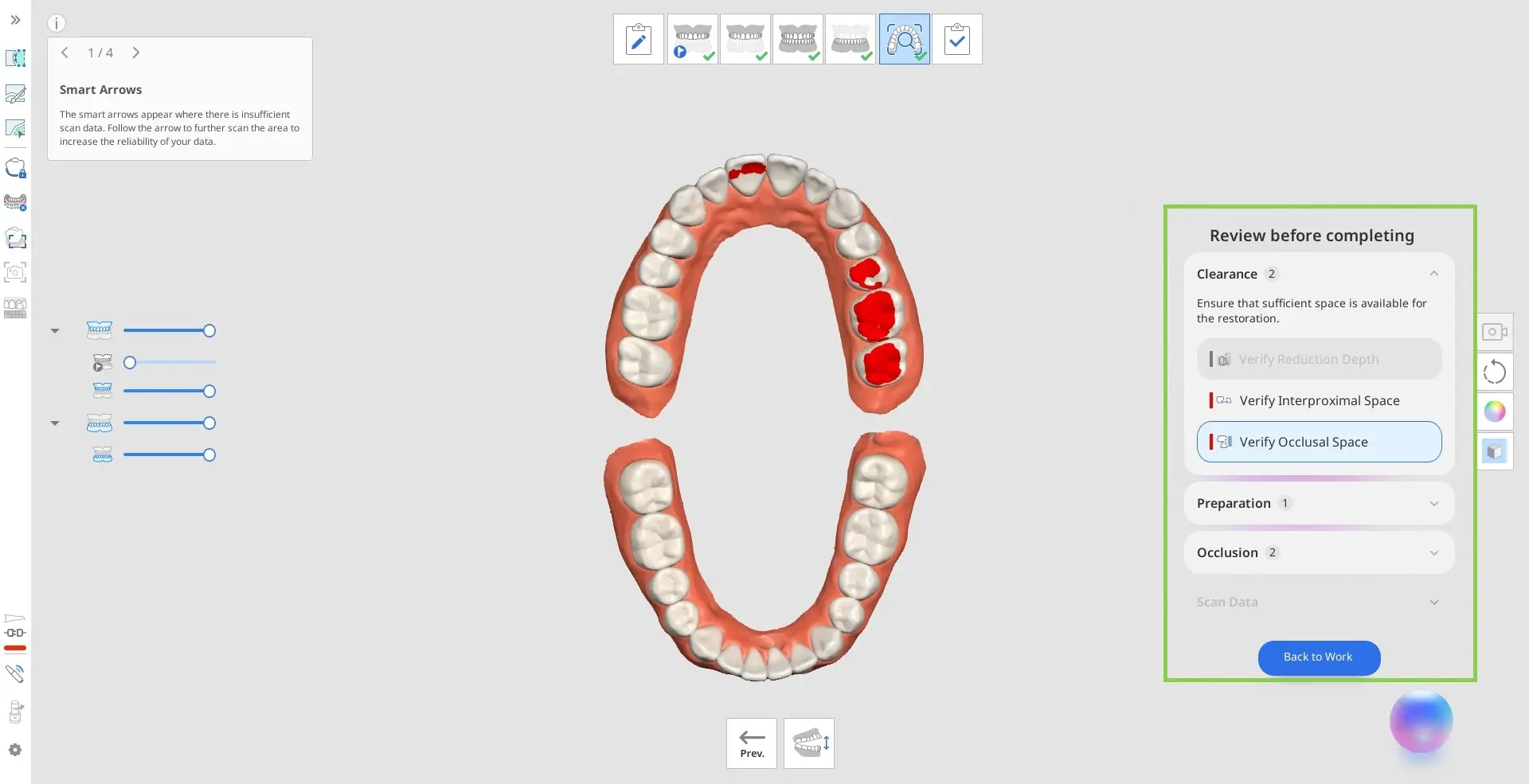
The feature is now part of Medit Scan for Clinics and Medit Link. It automatically looks for prepared teeth, checks whether the scan and preparation meet configurable requirements and presents a list of items for the clinician to review or correct.
The proposition is practical. A missing interproximal surface, insufficient occlusal clearance or a multilayered scan caused by saliva may be obvious to a laboratory technician hours later. At that point, the practice may need to recall the patient, alter the prescription or accept a compromised starting point.
Realtime Intelligence tries to move that conversation forward—from the laboratory inbox to the scanning appointment.
The important questions are what the software measures, which cases it supports, how much it costs and whether its alerts have been independently shown to reduce remakes.
What the software checks
Medit divides Realtime Intelligence feedback into four categories.
Clearance
The software can:
- measure space between the preparation and opposing teeth;
- assess interproximal space beside the preparation;
- compare pre-operative and prepared scans to estimate reduction depth.
Users can configure the distance thresholds. Areas below the selected value are highlighted, and the interface can display the measured distance.
This is useful, but it also means the result is only as appropriate as the threshold. The required reduction depends on the restoration, material, preparation geometry, manufacturing process and laboratory protocol. A red warning is not a universal treatment rule.
Preparation
Realtime Intelligence automatically proposes an insertion axis and highlights undercuts that may interfere with seating. It also creates a colour visualization of convexity, concavity and roughness around the margin.
The margin display is an aid for inspection; it is not proof that the finish line is clinically visible or correctly located. Blood, saliva, retraction, subgingival anatomy and scan artefacts can still affect what the digital model represents.
Occlusion
The system reviews occlusal distances and contact points, looking for possible interference or imbalance. When pre-operative occlusal data are available, it can compare patterns before and after preparation.
This may help operators notice an implausible bite alignment before sending the case. It does not replace clinical verification of the patient’s actual intercuspation or functional contacts.
Scan data
The software highlights regions with insufficient information and areas containing overlapping or multilayered data. Medit says those layers may arise from blood, saliva, tooth movement or scanning technique.
Users can delete and rescan the affected area or run an optimization step. The system can also save up to five HD images per prepared tooth from occlusal, buccal, lingual, mesial and distal views.
This may be the least glamorous part of Realtime Intelligence and one of the most valuable. A complete, clean data set is a prerequisite for every later stage, regardless of how sophisticated the design software becomes.
It is not a universal restorative checker
The product name suggests a broad layer of intelligence, but Medit’s own documentation defines a narrower scope.
Realtime Intelligence currently supports crowns and inlays/onlays. It is not available for veneers or bridges. The relevant icon only appears in the pre-operative, maxillary or mandibular, and occlusion stages.
The review also depends on how the case is configured.
For a workflow with pre-operative data, Medit recommends placing the arch containing the prepared tooth at the end. Without a pre-operative scan, the occlusion stage should come last. Some review items will not appear if the required data have not been captured in the expected order.
Other published limitations include:
- the feature cannot operate simultaneously with Medit’s SmartX workflow;
- Smart Arrows are automatically enabled while Realtime Intelligence is active;
- some scan-data checks require Smart Scan Filtering to be set to Teeth + Gingiva;
- the feature is disabled when GPU processing is turned off;
- manually selecting a tooth or modifying a margin line may affect the result;
- review is triggered only after a minimum number of captured frames.
Medit lists different frame requirements by scanner and scanning mode. For example, a partial-arch “Smooth & Steady” scan requires at least 800 shots, while a “Fast & Furious” full-arch scan requires at least 2,500. The company cautions that these minimums may change without notice.
These are not minor setup details. They determine whether the advertised checks are actually performed.
The commercial model creates two classes of Medit owner
Realtime Intelligence is included at no additional charge with the Medit i900, i900 classic and i900 Mobility.
Owners of eligible i600, i700 and i700 wireless scanners need an optional licence. Medit’s US online store lists the full licence at $2,000. The licence is tied to the scanner’s serial number and cannot be transferred to another device after activation.
Medit is offering eligible legacy-scanner users complimentary access through December 31, 2026. The i500 is not supported.
That arrangement turns a software feature into part of the hardware-upgrade equation.
An i700 owner considering the licence should compare:
- the $2,000 device-bound cost;
- the remaining service life and resale value of the scanner;
- the price difference to an i900-family upgrade;
- the practice’s volume of supported restorative cases;
- the current rate and cost of rescans, remakes and patient recalls;
- whether the laboratory already performs an effective incoming-scan review.
The licence could pay for itself in a high-volume restorative practice if it prevents a modest number of costly repeat appointments. That calculation needs the practice’s own baseline data. A promise of “fewer remakes” is not an economic model.
Regional price, eligibility and commercial terms may differ. Medit’s store says availability depends on scanner model, serial number, region and commercial policy.
“Realtime” still includes pauses and review
The feature’s name may imply continuous analysis during every scanner movement. Medit’s documentation describes a more specific sequence.
When scanning stops, the software searches for prepared teeth and performs its review. Results are refreshed when data are added, trimmed, optimized or transferred between stages. An enhanced Smart Scan Review summarizes actionable items before the case is completed.
This remains real-time in the clinically meaningful sense: feedback is available during the appointment, while corrective action is still possible.
It is not autonomous approval. The clinician must interpret each alert, decide whether the threshold is appropriate and choose whether additional reduction, tissue management, bite reacquisition or rescanning is justified.
That distinction matters. A false-negative result could allow a deficient case to proceed. A false-positive alert could encourage unnecessary tooth reduction or waste chair time. The safest role is decision support, not decision replacement.
The validation gap
Medit says Realtime Intelligence can improve data quality, make later design work more accurate and reduce remanufacturing and patient return visits. Those are plausible outcomes. They require evidence at several levels.
Technical validation should report how accurately the software:
- identifies prepared teeth;
- measures occlusal and interproximal clearance;
- estimates reduction from registered pre-operative data;
- detects undercuts and proposes an insertion axis;
- identifies incomplete and multilayered scan regions;
- recognizes clinically unacceptable bite relationships.
Clinical validation should then show whether using the software changes behaviour and outcomes:
- Are operators more likely to correct a deficient scan?
- Does the laboratory reject fewer submissions?
- Are marginal and internal adaptation improved?
- Do chairside adjustments decline?
- Are remakes and patient recalls reduced?
- Does the benefit persist across operators with different experience?
As of July 23, 2026, Digital Dentistry Daily did not identify a peer-reviewed clinical study evaluating Realtime Intelligence itself. Medit’s public documentation does not disclose the algorithm architecture, training data, independent test set, error rates or performance by scanner model and restoration type.
Research in adjacent areas supports the general concept but cannot validate this product.
A study of 1,312 single-crown digital models found that structured software evaluation could identify preparation and model-quality issues relevant to clinician–technician communication. More recent reviews suggest AI-assisted crown-design systems can produce clinically acceptable fit, but many included studies carry moderate risk of bias and focus on design rather than chairside preparation assessment.
The distinction is important: evidence that automated crown design can work does not establish that a particular scan-review tool correctly flags clearance, margins or occlusion.
What practices should test during the free-access period
The complimentary period for eligible i600 and i700-family owners creates an opportunity to run a local audit before buying the licence.
A practice could record, for consecutive supported cases:
- which Realtime Intelligence alerts appeared;
- whether the clinician agreed with each alert;
- what corrective action was taken;
- whether the laboratory found an additional problem;
- whether the restoration required substantial adjustment, remake or patient recall;
- how much extra scanning and review time the feature added;
- whether the result differed between experienced and less-experienced operators.
The practice should keep the thresholds, scanner model, software version and workflow configuration consistent during the audit. Cases should not be judged only by whether the software displayed green checks; the final laboratory and clinical outcomes matter.
Laboratories can help by tagging incoming cases with standardized reasons for rejection or clarification. That creates the feedback loop needed to determine whether chairside alerts address the clinic’s actual failure modes.
A meaningful shift—if the alerts prove reliable
Realtime Intelligence reflects a broader change in intraoral scanning.
Scanner manufacturers are increasingly competing on what happens around image capture: automated quality review, preparation analysis, treatment communication, cloud collaboration and links to design and manufacturing. The scanner is becoming a data-acquisition point inside a software-defined restorative workflow.
Medit’s implementation addresses a real problem. Discovering an inadequate scan before the patient leaves is better than discovering it after the laboratory opens the file.
The current product is narrower and more conditional than the name suggests. It supports selected single-unit restorative workflows, depends on stage order and system settings, and carries a significant licence cost for eligible older scanners.
The remaining question is not whether the interface can display useful-looking warnings. It is whether those warnings are accurate, actionable and capable of improving outcomes outside a manufacturer demonstration.
For i900 users, enabling and auditing the included feature is a reasonable step. For i600 and i700 owners, the free-access period should be treated as a structured evaluation—not merely a preview before a $2,000 purchase.
Compatibility and cost
| Scanner | Published availability |
|---|---|
| Medit i900, i900 classic, i900 Mobility | Included at no additional charge |
| Medit i600, i700, i700 wireless | Optional, device-bound licence |
| Medit i500 | Not supported |
| Published US legacy-scanner licence price | $2,000 |
| Eligible legacy-scanner promotion | Complimentary access through December 31, 2026 |
| Supported restorative cases | Crowns and inlays/onlays |
| Not currently supported | Veneers, bridges and SmartX workflows |
Sources
- Medit Help Center, “Realtime Intelligence.” Updated July 23, 2026. Accessed July 23, 2026.
- Medit, “Software Update: Medit Link v3.4.11.” June 9, 2026. Accessed July 23, 2026.
- Medit, “Software Update: Medit Link v3.4.12.” June 30, 2026. Accessed July 23, 2026.
- Medit Shop, “Realtime Intelligence.” Accessed July 23, 2026.
- Medit, “Medit i900.” Accessed July 23, 2026.
- Dental Tribune International, “Medit announces global launch of Realtime Intelligence.” July 15, 2026. Accessed July 23, 2026.
- “Investigation on the quality analysis of 1,312 single crown digital models.” West China Journal of Stomatology. 2022;40(1):33–38.
- Alfaifi MA. “A Systematic Review of the Accuracy of Crowns Designed Using Artificial Intelligence Versus CAD/CAM and Traditional Methods.” Medicina. 2026;62(3):567.
- Holiel AA, Al Nakouzi MM, Cuevas-Suárez CE, et al. “Accuracy and Functional Performance of Artificial Intelligence-Based Automated Crown Design Systems: A Systematic Review and Meta-Analysis.” Biomedical Engineering and Computational Biology. 2026;17.
Image credit
Medit, official Realtime Intelligence Help Center screenshot. Editorial use remains subject to Medit’s media terms.
Editorial disclosure
This article analyzes manufacturer documentation, published commercial terms, independent news coverage and peer-reviewed research. It was independently written, was not sponsored and contains no affiliate links. Digital Dentistry Daily had not independently tested Realtime Intelligence at the time of writing. Product names and trademarks belong to their respective owners.
About the author