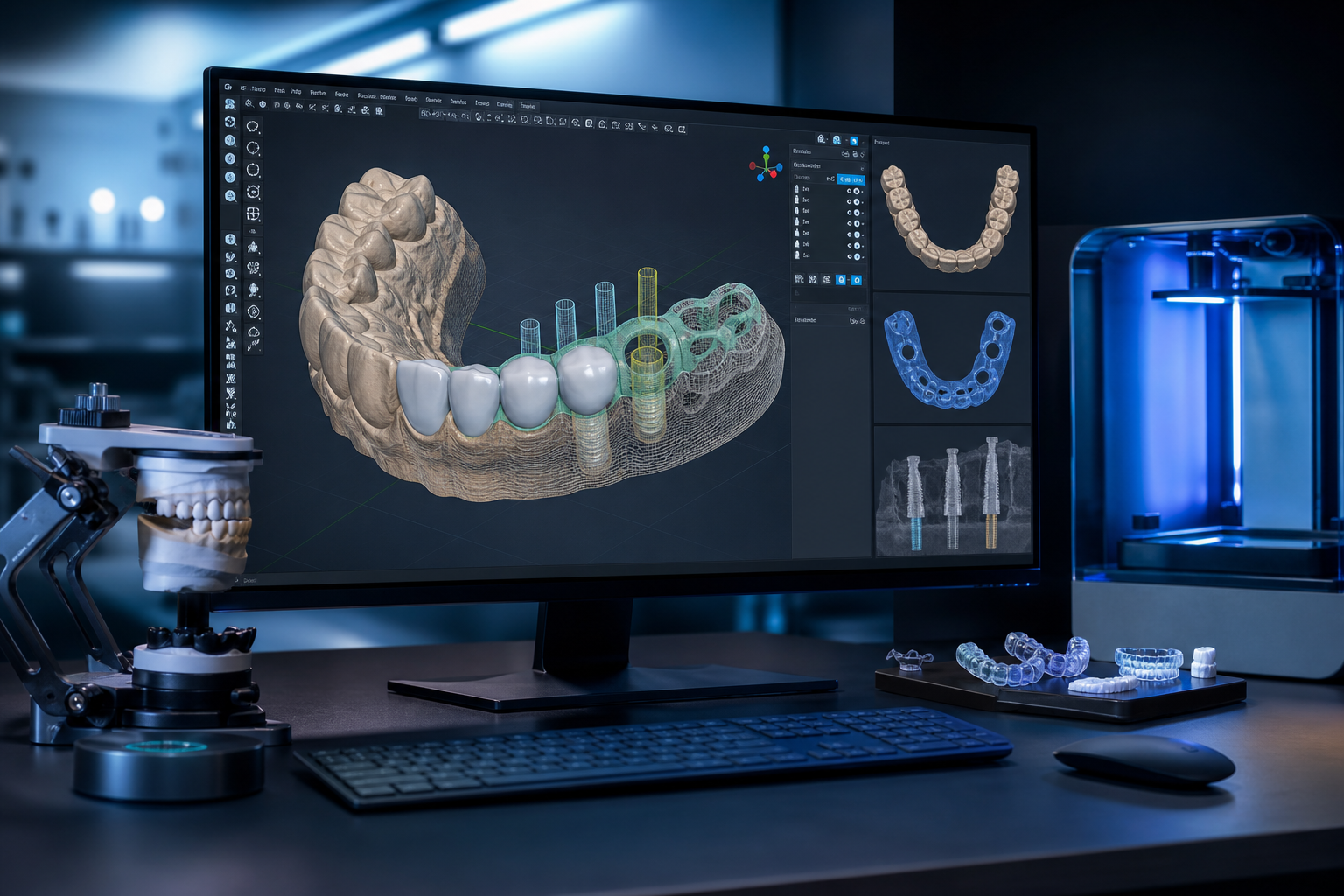
For years, dental CAD has largely meant choosing between powerful closed platforms, expensive annual subscriptions, and workflow ecosystems that often feel difficult to leave once a lab or clinic is fully invested.
Blender for Dental is interesting because it challenges that model from a very different direction.
Instead of building from a proprietary 3D core, Blender for Dental is built around Blender — the free and open-source 3D software used worldwide in design, animation, engineering, and digital fabrication. On top of that base, Blender for Dental adds a growing set of dental-specific modules intended to make real production tasks more practical for clinicians, technicians, and design teams.
That does not automatically make it the right solution for every laboratory. But it does make it one of the most important software developments to watch in digital dentistry.
What Blender for Dental actually is
Blender for Dental is not one single monolithic CAD package in the traditional sense. It is a modular dental add-on ecosystem built on Blender.
According to the official BlenderforDental website as reviewed on July 27, 2026, the platform offers individual modules for workflows such as Crown & Bridge, Denture Designer, Guide Designer, Gum Designer, Articulator & Facebow, All-On-X Hybrids, Tray Designer, and implant-focused tools including iBar and iAbutment & Bar. The same official site also states that tutorials are included, modules start from USD 79, the software can be installed on three computers, and the overall value proposition is specifically positioned against recurring subscription-heavy CAD systems.
That framing matters because Blender for Dental is not trying to win by saying, “Here is another closed platform.” It is trying to win by saying, “Here is a lower-cost, skill-driven digital workflow built on software you can actually understand and control.”
Why the platform is getting attention
There are four reasons Blender for Dental is attracting serious attention.
1. The cost structure is different
This is the most obvious reason, but it is not a minor one. Dental CAD has long been one of the most expensive software layers in the digital workflow. Blender for Dental pushes hard in the opposite direction: buy modules as needed, avoid annual license pressure, and build capability gradually.
For small labs, start-up clinics, in-house designers, and teaching environments, that changes the conversation immediately.
2. It expands what “open-source in dentistry” can mean
Blender itself is already a mature open-source 3D environment. Blender for Dental shows what happens when that base is adapted with dental purpose instead of generic modeling logic. This is bigger than software pricing. It is about control, customization, and the idea that dental design does not always have to live inside a locked commercial architecture.
3. The workflow range is broader than many people expect
Some people still assume Blender for Dental is only a model builder or a hobbyist side path. That is outdated. The official module lineup now spans printed models, removable work, implant planning tools, denture design, guide design, and restorative design categories that place it much closer to mainstream lab production conversations.
4. It appeals to users who want to stay in control
The software’s messaging has become increasingly clear on this point. A March 6, 2026 BlenderforDental article described the platform as “human-led digital dentistry” and emphasized skill, control, and understanding over black-box automation. Whether one agrees with every part of that philosophy or not, it resonates strongly with technicians who do not want software to decide too much for them.
Where Blender for Dental looks strongest today
Its strongest appeal is probably not to every chairside scanner user looking for instant, automatic restorative proposals.
Its strongest appeal is to digitally curious users who want a more flexible design environment and are willing to invest time in learning it well.
That includes:
- labs that want to lower CAD overhead without abandoning advanced design capability
- technicians who already think visually in 3D and want more manual control
- implant and full-arch designers who value customizable workflows
- education programs that need a lower-cost path into serious digital dentistry
- clinicians or in-house designers building a staged digital workflow instead of buying everything at once
In those settings, Blender for Dental can be more than a budget alternative. It can become a genuine design platform.
The trade-offs are real
That said, the platform should not be described as frictionless. The learning curve is real.
Blender is powerful precisely because it is not narrow software. Even when dental tools are added, that power still demands orientation, discipline, and training. Users moving from highly simplified dental CAD environments may initially find Blender for Dental less immediate, not more.
There is also an important difference between software access and workflow maturity. Lower entry cost does not remove the need for design judgment, print understanding, bite control, implant logic, or production verification. In the wrong hands, cheap software can still produce expensive mistakes.
That is why the real question is not whether Blender for Dental is “cheap.” The real question is whether a lab or clinician is prepared to build skill on top of it.
Why 2026 matters
One sign that Blender for Dental should be taken seriously is that it appears to be actively tracking the evolution of Blender itself rather than standing still. In an official BlenderforDental post dated November 4, 2025, the team highlighted Blender 4.5 and stated that it had already been testing the new version in beta for over three months before public rollout. That does not prove long-term success on its own, but it does suggest a platform that understands the importance of compatibility and release discipline.
That point matters because open-source-based dental workflows only become credible if they stay usable across real software cycles, hardware changes, and production needs.
The bigger significance
Blender for Dental is important not only because of what it sells, but because of what it represents.
It represents a push toward digital dentistry that is:
- less dependent on annual software rent
- more modular in how capability is added
- more open to customization
- more educational for the operator
- more compatible with the idea that expertise should remain visible inside the workflow
That does not mean it replaces every mainstream CAD platform today. It does mean the market can no longer dismiss open-source-based dental design as a fringe idea.
Bottom line
Blender for Dental is no longer just an intriguing outsider.
It is becoming one of the clearest signs that dental CAD is starting to diversify beyond the old closed-platform model. For technicians and clinicians who value flexibility, controllable cost, and deeper design ownership, that is a serious development.
The most important takeaway is simple: Blender for Dental is not promising effortless dentistry. It is promising more freedom for people willing to learn.
And in digital dentistry, that may turn out to be one of the most disruptive promises of all.
Sources reviewed July 27, 2026: BlenderforDental official website, BlenderforDental official blog post dated March 6, 2026, and BlenderforDental official blog post dated November 4, 2025.
About the author