Excerpt: Planmeca’s latest Romexis 7 update brings AI tools into intraoral imaging, not just CBCT workflows. The move may look incremental, but it points to a bigger shift: AI becoming part of routine image organisation rather than a separate premium event.
AI in dentistry often gets marketed at the diagnostic frontier.
That is where the headlines usually go: CBCT interpretation, anomaly detection, treatment planning support, and image enhancement. But some of the more important changes in daily clinical workflow are happening somewhere less dramatic — in the repetitive tasks that slow teams down every day.
That is why Planmeca’s expansion of AI tools inside Romexis 7 deserves more attention than a quick product note might suggest.
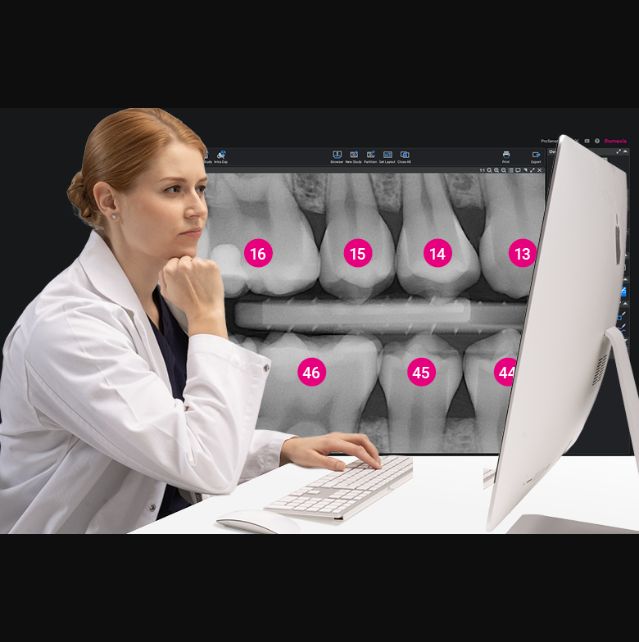
In its January 20, 2026 release, Planmeca announced that the AI-powered tools built into Romexis 7 now extend to intraoral imaging. According to the company, the software can automatically detect and number teeth in intraoral X-ray images, correct orientation when needed, and organise images into study templates. These features are included as standard within the Romexis 7 licence rather than positioned as a separate premium AI add-on.
On the surface, that may not sound revolutionary. It does not promise autonomous diagnosis. It does not claim to replace interpretation. It does not even try to market itself as a dramatic clinical breakthrough.
That is precisely why it matters.
The value of AI in real practice is often less about spectacular decisions and more about friction reduction. Intraoral imaging generates a constant stream of routine organisational work: sorting images, checking orientation, assigning tooth numbers, verifying template placement, and making sure the patient record stays coherent. None of those tasks are glamorous, but all of them consume attention. When they happen dozens of times per day, they quietly shape how efficient a practice feels.
Planmeca’s update is notable because it targets that layer directly.
The company says the software now identifies teeth automatically in intraoral X-ray images and assigns numbers, with the clinician only needing to verify and adjust when necessary. That framing is important. It positions AI as workflow support, not as a black-box authority. In other words, the software is helping organise the record, while the clinician remains responsible for the final judgment.
That is a much more realistic and useful use case than many broader AI claims currently circulating in the dental market.
It also fits a wider trend that is becoming easier to see in 2026. The most practical AI tools in dentistry are increasingly the ones that disappear into the infrastructure. They do not ask the user to open a separate AI module or learn a separate system. They sit inside the software people already use and remove small but repeated sources of manual work.
That kind of integration matters because Planmeca is not selling Romexis as an isolated imaging viewer. The company continues to position it as the centre of a broader connected workflow that spans 2D imaging, CBCT, intraoral scanning, diagnostics, treatment planning, and CAD/CAM collaboration. In that environment, even seemingly small AI automations can have outsized effects because they improve the quality and consistency of the data flowing through the rest of the system.
There is also a strategic point here.
By including these intraoral AI tools as part of the standard Romexis 7 licence, Planmeca is making a quiet statement about where it believes the market is heading. AI is not being framed as a luxury tier reserved for a few advanced users. It is being treated more like a baseline software behavior — something that should simply make the system better for everyone.
That may prove more influential than many splashier launches.
If the future of digital dentistry is truly connected, then consistency becomes just as important as capability. A workflow only becomes scalable when the images are organised correctly, the records are structured properly, and the clinician does not have to spend unnecessary mental energy on tasks the software could handle safely. AI that improves those foundational steps may not generate dramatic before-and-after demos, but it can still change how a clinic functions.
That said, the right level of caution still applies.
Automatic numbering and image organisation are not the same as diagnostic validity. These tools should be judged by how reliably they reduce clerical workload without creating new correction burdens. If a team spends too much time fixing AI mislabelling, the value collapses quickly. The long-term success of this kind of software will depend less on the word “AI” and more on whether the automation is accurate enough to feel invisible.
That is the real test.
Still, Planmeca’s move is a meaningful one because it treats AI as part of routine clinical infrastructure rather than a separate digital spectacle. And in practice, that may be where the most durable gains come from.
The future of imaging software may not belong to the tools that shout the loudest about intelligence.
It may belong to the ones that quietly remove friction from every patient record, every image set, and every clinical day.
Sources
About the author