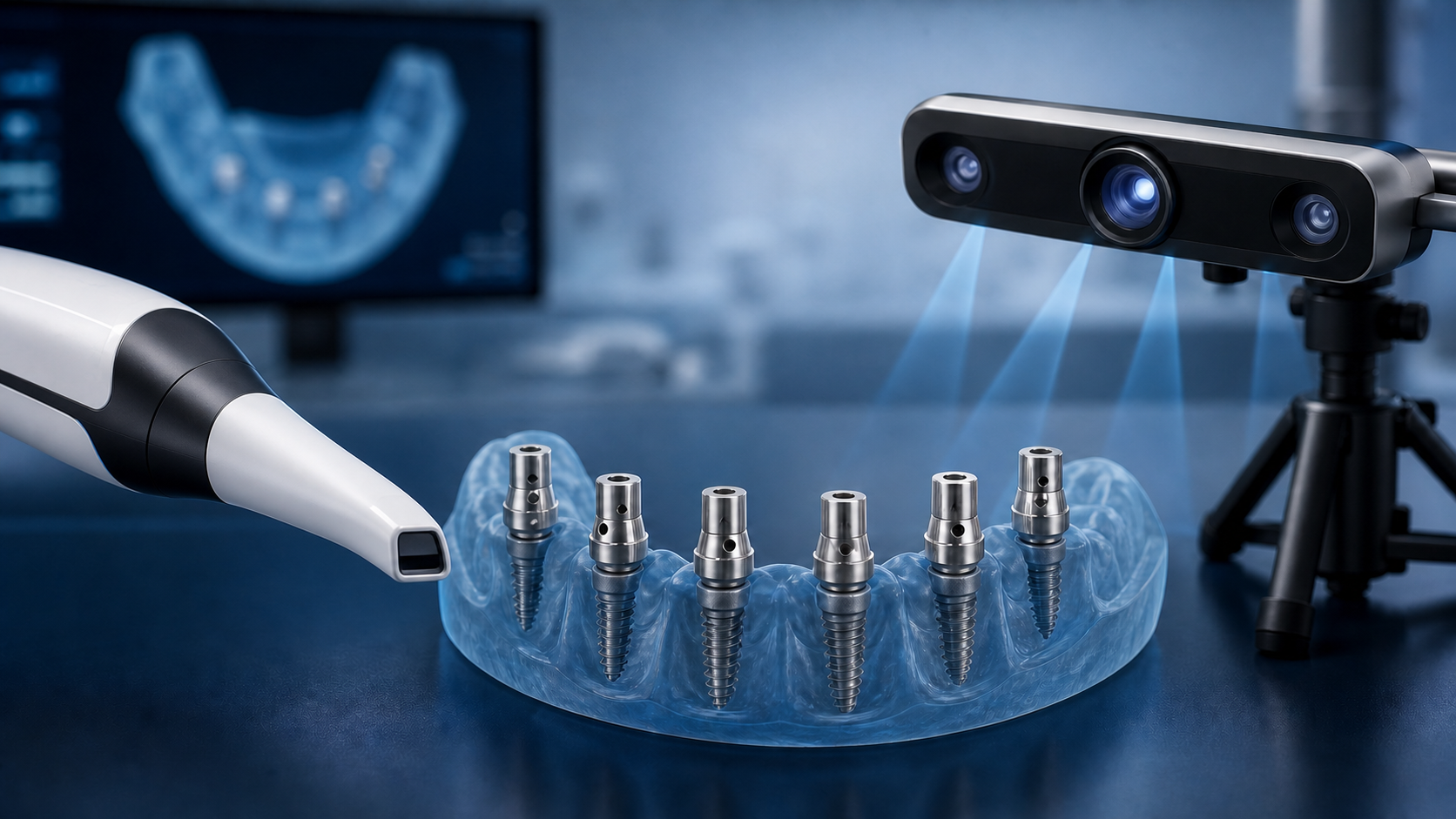
In digital implant dentistry, full-arch impressions are where the workflow still gets brutally honest.
Single units and short-span restorations are no longer the main question. The harder conversation now is what happens when the arch is fully edentulous, the implant distribution is unforgiving, and the margin for cumulative error becomes clinically meaningful. That is why a clinical study published on June 10, 2026 deserves real attention.
The paper, published in the International Journal of Oral Implantology, compared three impression strategies for complete-arch implant cases: intraoral scanning, dental photogrammetry, and conventional open-tray plaster impressions. Rather than testing only convenience or only lab measurements, the authors looked at three things clinicians actually care about at the same time: precision, patient satisfaction, and time.
That combination makes the findings more useful than many narrower bench-only comparisons.
The study included 20 participants with a completely edentulous maxilla or mandible restored on four to eight implants. Each participant underwent six impressions in total: two with an intraoral scanner, two with a photogrammetry system, and two with the conventional plaster technique. The team then evaluated positional and angular errors, recorded chairside time, and measured patient satisfaction through visual analogue scales.
The headline result is clear.
Photogrammetry was the most precise method in the group. It showed the lowest root mean square error at 0.030 ± 0.014 mm, compared with 0.117 ± 0.068 mm for intraoral scanning and 0.110 ± 0.045 mm for plaster impressions. It also produced the lowest global deflection error at 0.349 ± 0.499 degrees, compared with 1.140 ± 0.556 degrees for intraoral scanning and 0.901 ± 0.643 degrees for conventional impressions.
In plain terms, photogrammetry performed best when the question was how accurately the implant positions were captured across a complete arch.
That matters because full-arch implant work is exactly where small distortions stop being small.
When error accumulates across a longer span, passive fit becomes harder to achieve, verification becomes more important, and the consequences of a seemingly minor inaccuracy can extend into prosthetic adjustment time, remake risk, and long-term mechanical stress. So when a clinical study shows a measurable precision advantage for photogrammetry in edentulous implant cases, that finding should not be brushed aside as just another technical detail.
But the study becomes more interesting when you look beyond precision alone.
Intraoral scanning was the fastest method. Photogrammetry and plaster impressions both required more time. Patient satisfaction was also higher for the two digital techniques than for the conventional method. That means the real-world tradeoff was not digital versus analogue. It was faster digital capture with lower precision on one side, and more accurate but slower digital capture on the other.
That is a much more useful framing for clinicians than simplistic claims that one technology has already “won.”
For many practices, the practical question is not whether intraoral scanning is good. It is whether it is good enough for the specific full-arch indication being treated. This study suggests that in completely edentulous implant cases, photogrammetry still holds the stronger position when precision is the primary objective. At the same time, intraoral scanning remains attractive because it is faster, easier on patients, and already integrated into many routine digital workflows.
That is exactly why this matters commercially as well as clinically.
Scanner manufacturers have spent years pushing the idea that full-arch implant workflows can increasingly be handled inside a single intraoral scanning ecosystem. And to be fair, recent hardware and software improvements have narrowed the gap. A 2026 in vitro study in the Journal of Dentistry found that next-generation systems performed far better than older assumptions would suggest, with some platforms approaching photogrammetry-level trueness under controlled conditions. But the June 10, 2026 clinical study is a reminder that controlled in vitro promise and real edentulous clinical performance are not the same thing.
That distinction is where good editorial judgment matters.
It would be easy to over-read this study and conclude that intraoral scanning has failed in full-arch implant cases. That is not what the data show. It would be equally easy to under-read it and treat the precision gap as clinically irrelevant because scanning is faster and patients like it more. That would be too casual.
What the study really supports is a more mature view of digital workflow selection.
If speed, patient comfort, and workflow simplicity are the top priorities, intraoral scanning continues to make a strong case. If the highest achievable positional precision is the top priority in a completely edentulous implant case, photogrammetry currently appears to offer the stronger solution. And if a clinic is promising a fully digital full-arch workflow, it should be honest about which part of that promise is being optimized: convenience, integration, or accuracy.
That may be the most important takeaway.
Digital dentistry is moving past the stage where every tool needs to be marketed as universally superior. The better question is where each tool performs best, and where compromises start to matter. On that front, this June 10, 2026 clinical study is useful precisely because it makes the tradeoff visible instead of hiding it behind enthusiasm.
For full-arch implant impressions, photogrammetry still looks like the precision leader.
But intraoral scanning is not out of the conversation. It is simply being forced into a more realistic one.
Sources
- Nathalie Robert, Renaud Noharet, Eric Bechet, Adelin Albert, Marc Lamy. Precision, patient satisfaction and impression time with complete-arch digital implant impression with intraoral scanning, dental photogrammetry and conventional impressions: An experimental clinical study. International Journal of Oral Implantology. Published June 10, 2026.
- Francesco Guido Mangano et al. Trueness of extraoral photogrammetry, intraoral photogrammetry and direct intraoral scanning in the full-arch digital implant impression: a comparative in vitro study. Journal of Dentistry, February 2026.
About the author