Most new product launches in digital implant prosthetics promise speed, simplicity, or broader compatibility.
NikolasBase by Edison Medical is taking a different route. Its pitch is not really about faster design or prettier software screens. It is about something far more important in full-arch and multi-unit work: passive fit.
That makes it interesting.
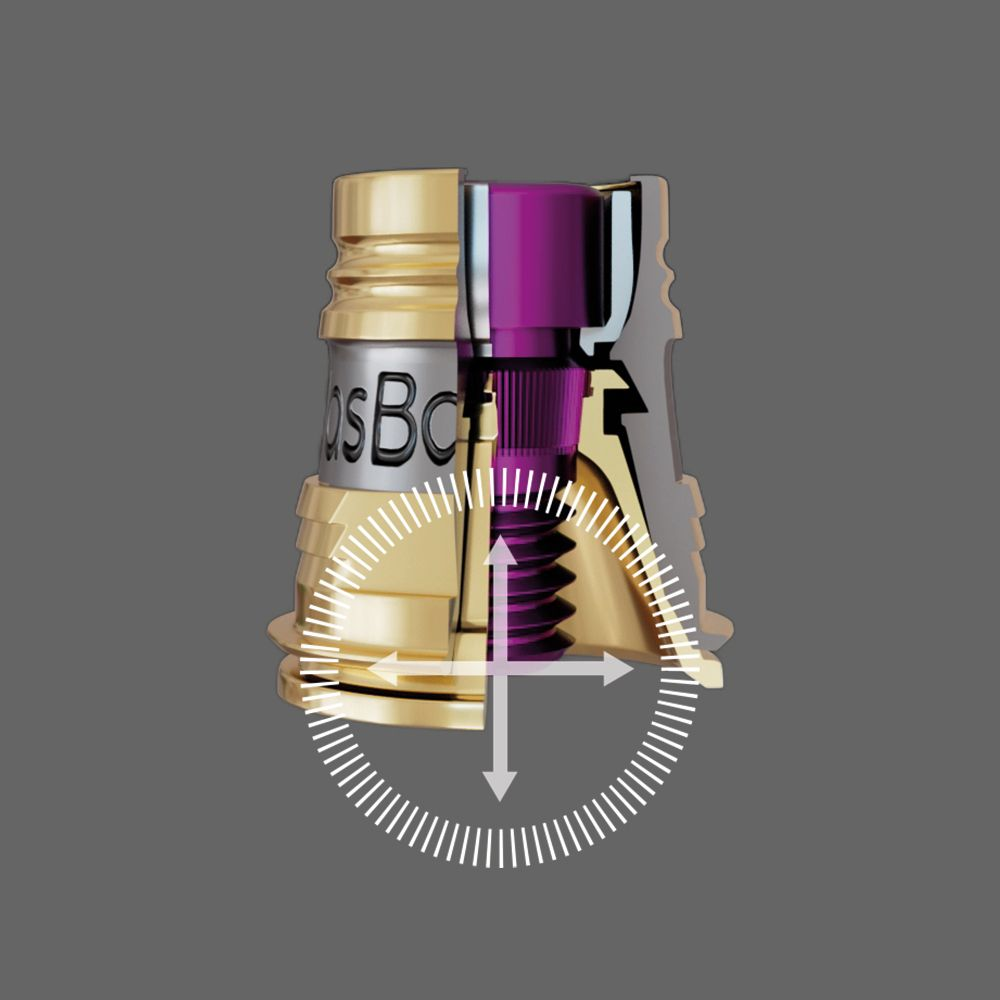
According to Edison Medical, NikolasBase is a self-adjustable adhesive cap designed to sit directly on multi-unit abutments. The company says the concept is intended to help compensate for small inaccuracies that can arise during intraoral scanning and downstream digital fabrication. In practical terms, the product is being positioned as a way to reduce implant stress, even out pressure distribution, and help clinicians and technicians achieve a more passive, tension-free screw-retained result.
That is a serious promise, because passive fit remains one of the hardest realities to control in digital full-arch work.
Even when digital workflows are efficient, they are not automatically forgiving. A case can move from scan to design to milling with impressive speed and still accumulate tiny inaccuracies along the way. In single-unit work, that may be manageable. In multi-unit and full-arch restorations, it becomes more consequential. Small deviations can turn into stress at the prosthetic level, more chairside adjustment, or uncertainty about whether the final assembly is truly as passive as it should be.
This is the gap NikolasBase is trying to address.
Edison Medical describes the system as “self-adjustable,” meaning each base is designed to compensate independently for slight misfits rather than forcing the entire framework to behave as one rigid, unforgiving structure. If that mechanism works consistently in real-world cases, the value could be substantial. The appeal is easy to understand: a component that absorbs minor mismatch before it becomes biomechanical stress is speaking directly to one of the daily frustrations of digital implant prosthetics.
That is also why NikolasBase feels more notable than a routine catalog extension.
This is not simply another compatible ti-base added to an already crowded restorative shelf. Edison already has a broader ecosystem of digital prosthetic components, including scan bodies, conventional CAD/CAM ti-bases, and its Clicq-Base and Uni-Base systems. NikolasBase appears to be the company’s attempt to push that platform one step further, from compatibility and workflow efficiency into adaptive fit behavior.
There are already clues that Edison sees it that way. On its own product page, the company calls NikolasBase its latest breakthrough in prosthetic innovation and frames it as a solution for digital workflows and full-arch restorations. The current listing specifies compatibility with Clicq multi-unit abutments, includes an M1.4 fixation screw, recommends a tightening torque of 22 to 25 Ncm, and notes Exocad library availability with 3Shape libraries expected later.
Those details matter because they show where Edison wants NikolasBase to live: not as an abstract R&D idea, but as a practical component inside an existing digital workflow.
There is also a second reason the launch is worth watching.
The market has spent years focusing on scan accuracy, scanner speed, and software intelligence. Those are still important. But as digital implant workflows mature, more of the real differentiation may shift toward what happens after the scan: how systems tolerate error, how they manage tension, and how they reduce the prosthetic consequences of minor mismatch. In that sense, NikolasBase fits a broader trend. The next phase of innovation may be less about capturing more data and more about making the restorative chain more resilient when the data is not perfect.
That does not mean the product is already proven.
At least from the public information currently available, Edison Medical is making a strong engineering claim, but not yet backing it with published independent clinical or mechanical data that would let the market judge how much adjustment is possible, under what conditions, and with what long-term tradeoffs. That is the right place to be cautious. A clever concept and a meaningful clinical advantage are not always the same thing, and full-arch prosthetics has a long history of products that sounded transformative before the evidence caught up.
Still, NikolasBase deserves attention precisely because it is aimed at a real problem.
Digital full-arch dentistry does not struggle because clinicians lack tools. It struggles because minor inaccuracy in complex implant cases can still have disproportionate consequences. A component designed to absorb those discrepancies rather than amplify them is, at minimum, a smart direction for product development.
If NikolasBase can reliably deliver the passive-fit benefit Edison Medical is promising, it could become more than a niche restorative part. It could represent a useful shift in how the market thinks about digital implant prosthetics: not just precision as capture, but precision as controlled adaptation.
And that is an innovation worth watching.
Sources
About the author